

What a 4,500-Year-Old Skeleton Reveals About Indian Ancestry - Storytrails
Every sight has a story to tell

What a 4,500-Year-Old Skeleton Reveals About Indian Ancestry

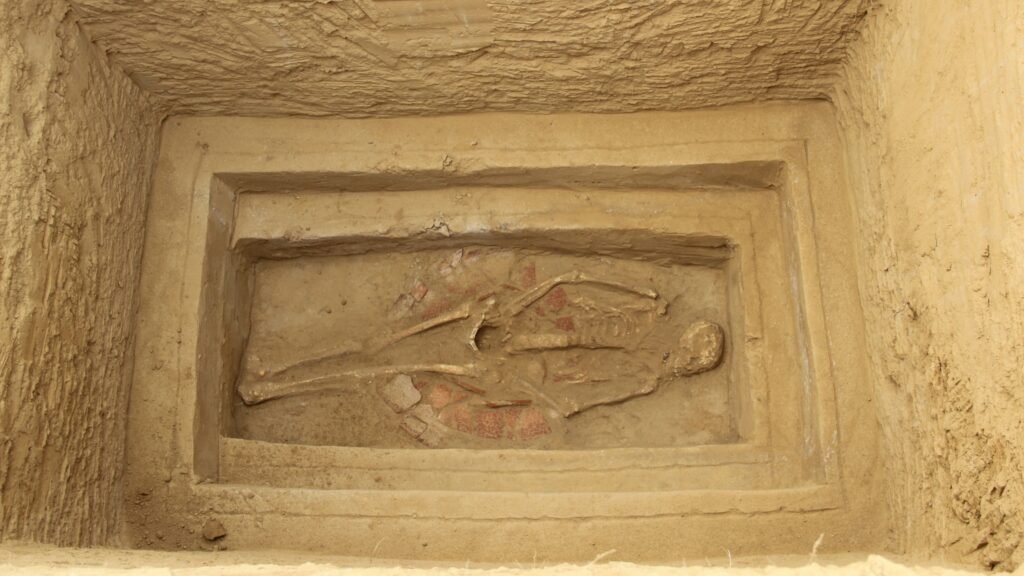
At Rakhigarhi in Haryana, archaeologists uncovered the 4500-year-old skeleton of a middle-aged woman from the Harappan period. Scientists recovered ancient DNA from her remains; the first successful genome from a Harappan individual. What makes this discovery significant, and what does it tell us about the ancestry of Indians?

1.Rakhigarhi Skeleton

Aadrit28, CC BY-SA 4.0 https://creativecommons.org/licenses/by-sa/4.0., via Wikimedia Commons

https://commons.wikimedia.org/wiki/File:Harappan_Burial_Remains_from_Rakhigarhi.jpg

2.Gandhara Buddha

Tokyo National Museum, Public domain, via Wikimedia Commons

https://commons.wikimedia.org/wiki/File:Gandhara_Buddha_(tnm).jpeg

3.Rakhigarhi

Durgeshkushvaha, CC BY-SA 4.0 https://creativecommons.org/licenses/by-sa/4.0., via Wikimedia Commons

https://commons.wikimedia.org/wiki/File:Rakhigarhi_Harappan_civilization.jpg

4.Rakhigarhi Skeletal remains

Gary Todd, CC0, via Wikimedia Commons

https://commons.wikimedia.org/wiki/File:Harappan_(Indus_Valley)_Burial_from_Rakhigarhi.jpg

5.The Economic Times, By Anubhuti Vishnoi, Jun 13, 2018

https://economictimes.indiatimes.com/news/politics-and-nation/harappan-site-of-rakhigarhi-dna-study-finds-no-central-asian-trace-junks-aryan-invasion-theory/articleshow/64565413.cms?from=mdr

6.The Caravan, Hartosh Singh Bal, 27 April, 2018

https://caravanmagazine.in/vantage/indus-valley-genetic-contribution-steppes-rakhigarhi

7.The Print, Fatima Khan, 06 September, 2019

https://theprint.in/india/aryan-invasion-theory-gets-a-setback-from-dna-study-of-2500-bc-rakhigarhi-skeletons/287454/

8.The Week, Rajalakshmi Karakulam,September 09, 2019 …

https://www.theweek.in/news/india/2019/09/09/aryan-invasion-or-confusion.html 

9.The New Indian Express, Ravi Shankar, 15 September 2019

https://www.newindianexpress.com/magazine/2019/Sep/14/its-all-in-the-genes-does-dna-call-bluff-on-aryan-invasion-theory-2032707.html

10.India Today, Sep 4, 2018

https://www.indiatoday.in/india/story/indus-valley-civilisation-rakhigarhi-dna-findings-1330719-2018-09-03

11.The Telegraph Online, 07.09.19

https://www.telegraphindia.com/india/rakhigarhi-dna-does-not-contain-aryan-genetic-trace/cid/1703089#goog_rewarded

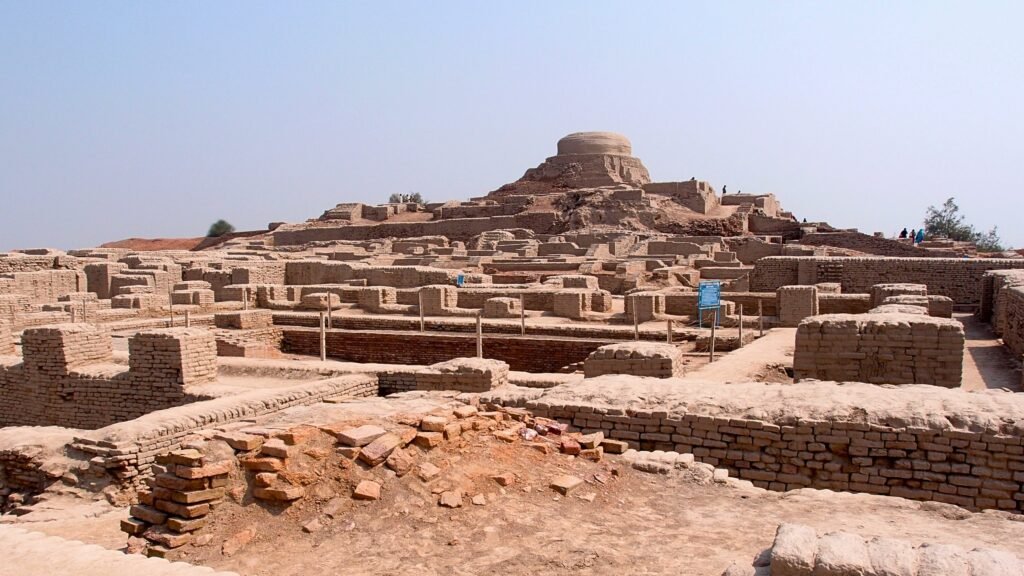
12.Mohenjo-daro

Saqib Qayyum, CC BY-SA 3.0 .https://creativecommons.org/licenses/by-sa/3.0., via Wikimedia Commons

https://commons.wikimedia.org/wiki/File:Mohenjo-daro.jpg

13.The Priest-King

Mamoon Mengal, CC BY-SA 1.0 .https://creativecommons.org/licenses/by-sa/1.0., via Wikimedia Commons

https://commons.wikimedia.org/wiki/File:Mohenjo-daro_Priesterk%C3%B6nig.jpeg

14.Terracotta boat in the shape of a bull

Sailko, CC BY 3.0 .https://creativecommons.org/licenses/by/3.0., via Wikimedia Commons

https://commons.wikimedia.org/wiki/File:Valle_dell%27indo,_barca_a_forma_di_toro,_periodo_kot-dijan,_2800-2600_ac_ca._(coll._priv.)_02.jpg

15.Harappan Burial Remains from Rakhigarhi

Aadrit28, CC BY-SA 4.0 .https://creativecommons.org/licenses/by-sa/4.0., via Wikimedia Commons

https://commons.wikimedia.org/wiki/File:Harappan_Burial_Remains_from_Rakhigarhi.jpg

16.Threshing near Sangrur, Punjab, India

CIAT, CC BY-SA 2.0 .https://creativecommons.org/licenses/by-sa/2.0., via Wikimedia Commons

https://commons.wikimedia.org/wiki/File:Threshing_harvest_Sangrur_Punjab_India.jpg

17.Traditional ploughing, Karnataka

Augustus Binu, CC BY-SA 3.0 .https://creativecommons.org/licenses/by-sa/3.0., via Wikimedia Commons

https://commons.wikimedia.org/wiki/File:Traditional_ploughing_-_Karnataka.jpg 

18.A farmer and his cows

Jayaseerlourdhuraj, CC BY-SA 3.0 .https://creativecommons.org/licenses/by-sa/3.0., via Wikimedia Commons

https://commons.wikimedia.org/wiki/File:A_farmer_and_his_cows.jpg

19.Woman harvesting wheat, Madhya Pradesh, India

© Yann Forget / Wikimedia Commons

https://commons.wikimedia.org/wiki/File:Woman_harvesting_wheat,_Raisen_district,_Madhya_Pradesh,_India.jpg

20.Harappan Seal

Cleveland Museum of Art, CC0, via Wikimedia Commons

https://commons.wikimedia.org/wiki/File:Clevelandart_1973.161.jpg

21.Harappan Seal

Cleveland Museum of Art, CC0, via Wikimedia Commons

https://commons.wikimedia.org/wiki/File:Clevelandart_1973.160.jpg 

22.Genetic ancestry timeline based on ‘An Ancient Harappan Genome’

Shinde et al. 2019, CC BY-SA 4.0 .https://creativecommons.org/licenses/by-sa/4.0., via Wikimedia Commons

https://commons.wikimedia.org/wiki/File:An_Ancient_Harappan_Genome.jpg 

Graphic Recreated based on Shinde, V. et al. (2019). An Ancient Harappan Genome Lacks Ancestry from Steppe Pastoralists or Iranian Farmers.Cell, 179(3), 729–735.e10. https://doi.org/10.1016/j.cell.2019.08.048 

END OF STORY

Share:

Facebook
Twitter
LinkedIn
WhatsApp
Pinterest
Email

You might also be interested in

An ancient pillar that has been worshipped for centuries. And a Greek ambassador who declared himself a devotee of Vasudeva. Around the 2nd century BCE, Heliodorus, an ambassador from the Indo-Greek kingdom, erected a pillar at Besnagar in central India. Its Brahmi inscription identifies him as a devotee of Vasudeva. The Heliodorus Pillar at Vidisha offers a fascinating glimpse into the cultural exchanges that shaped ancient India.
Burial sites are among the most important sources of information for archaeologists. The excavations at Keeladi, Adichanallur, Korkai and other places in Tamil Nadu have thrown up a host of burial urns, skeletal remains and other grave goods. These finds reveal much about the oldest settlements in south India through the ways in which they dealt with death. This video, the latest in our series around the Keeladi excavations, explores the different burial rites and practices of ancient Tamils and how they help us understand our history and cultures of the past better.
Meet Charles Masson, a soldier turned archaeologist and numismatist. During his lifetime, he was largely unacknowledged for the staggering amount of excavation work he carried out in Afghanistan and parts of modern-day Pakistan, which led to the discovery of entire new chapters in history. He was also the first European to discover the ruins of Harappa, one of the most important the Indus Valley Civilisation sites. This is his story.
What connects a pair of gigantic silver jars in the Jaipur city palace to the Cellular Jail in the Andaman? Surprisingly, a long-held Indian taboo called Kalapani that prevented Indians from traveling overseas. This is the story of a clever workaround that the British used, to move Indian soldiers across the world during World War I.