

1.The Rulers of the Mughal Dynasty from Babur to Aurangzeb, with their Ancestor Timur
Khalili Collections / CC-BY-SA 3.0 IGO, CC BY-SA 3.0 IGO <https://creativecommons.org/licenses/by-sa/3.0/igo/deed.en>, via Wikimedia Commons
https://commons.wikimedia.org/wiki/File:Khalili_Collection_Islamic_Art_mss_0874.3.jpg
2.Aurangzeb, The Ruler of the Mughal Dynasty
1707-12 artist, Public domain, via Wikimedia Commons
3.Portrait of Shah Jahangir
Attributed to Abu al-Hasan (1589-1630), Public domain, via Wikimedia Commons
https://commons.wikimedia.org/wiki/File:Jahangir_-_Abu_al-Hasan.jpeg
4.Mirza Khusrau
Gurkan1526, CC BY-SA 4.0 <https://creativecommons.org/licenses/by-sa/4.0>, via Wikimedia Commons
https://commons.wikimedia.org/wiki/File:Sultan-Khusrow2.png
5.Mirza Shahryar
Mughal Artist, CC BY-SA 4.0 <https://creativecommons.org/licenses/by-sa/4.0>, via Wikimedia Commons
https://commons.wikimedia.org/wiki/File:Mirzashahryr.png
6.Shah Jahan
Bichitr, Public domain, via Wikimedia Commons
7.Dara Shikoh
Public domain, via Wikimedia Commons
https://commons.wikimedia.org/wiki/File:Dara_Shikoh.jpg
8.Murad Baksh, youngest son of Shah Jhan
British Museum, Public domain, via Wikimedia Commons
9.Portrait of Shah Shuja
Rijksmuseum, CC0, via Wikimedia Commons
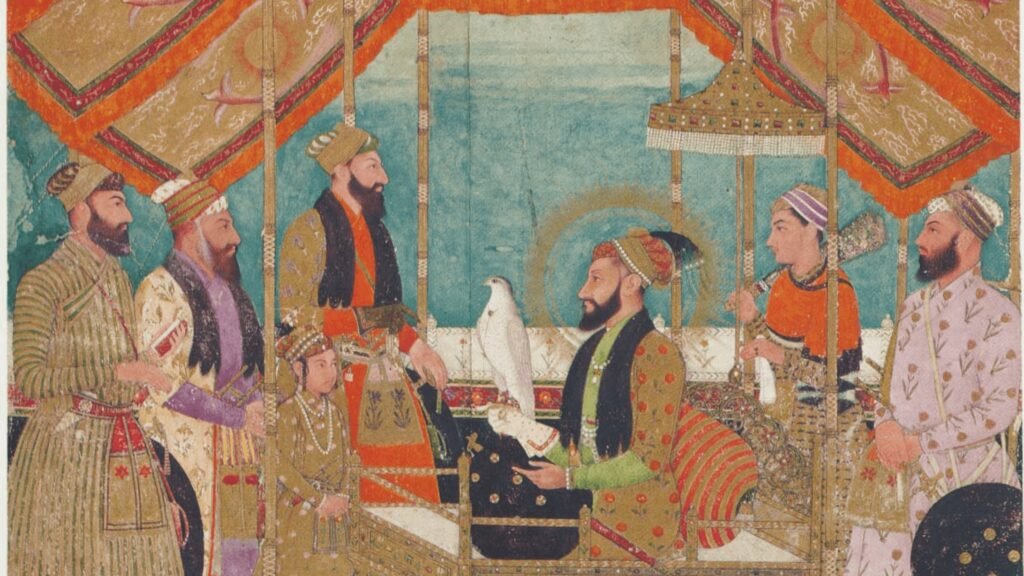
10.Emperor Aurangzeb with a Bird in hand.
Darbarscene.jpg: Cordanradderivative work: Rani nurmai, Public domain, via Wikimedia Commons
https://commons.wikimedia.org/wiki/File:Aurangzeb-portrait.jpg
11.Prince Aurangzeb facing a maddened elephant named Sudhakar on the battle field
Govardhan, Public domain, via Wikimedia Commons
12.Shah Jahan and Aurangzeb
Anup Chattar, Public domain, via Wikimedia Commons
https://commons.wikimedia.org/wiki/File:Shah_Jahan_and_Aurangzeb.jpg
13.The Severed Head of Dara Shikoh presented before Aurangzeb
AnonymousUnknown author, Public domain, via Wikimedia Commons
https://commons.wikimedia.org/wiki/File:The_Slave_Nazir_Present_to_the_Emperor_Aurangzeb_Dara_Shikoh%27s_Head._Golconda,_1678-1686,_Biblioteque_Nazionale_de_France,_Paris.jpg
14.Portrait of Aurangzeb
Cleveland Museum of Art, CC0, via Wikimedia Commons
15.Mirza Sulaiman Shikoh
Gurkan1526, CC0, via Wikimedia Commons
https://commons.wikimedia.org/wiki/File:Sulaiman-S.png
16.Portrait of Siphirshikoh
Mughal Artist, CC BY-SA 4.0 <https://creativecommons.org/licenses/by-sa/4.0>, via Wikimedia Commons
https://commons.wikimedia.org/wiki/File:Siphirshikoh.png
17.Mirza Muhammad Sultan
Gurkan1526, CC0, via Wikimedia Commons
https://commons.wikimedia.org/wiki/File:Muhhamad-sultan.png
18.Portrait of Zeb-un-Nissa Looking into a Mirror
https://libwww.freelibrary.org/digital/item/68264, Public domain, via Wikimedia Commons
19.Marriage of Prince Aurangzeb
https://www.rawpixel.com/image/11923037/image-face-person-art
rawpixel website
20.Aurangzeb enthroned in a darbar
Bichitr, Public domain, via Wikimedia Commons
https://commons.wikimedia.org/wiki/File:Aurangzeb_enthroned_in_a_darbar_scene.jpg
21.Map of the Mughal Empire
Avantiputra7, CC BY-SA 4.0 <https://creativecommons.org/licenses/by-sa/4.0>, via Wikimedia Commons
https://commons.wikimedia.org/wiki/File:Mughal_Empire,_1707.png
22.The Emperor Aurangzeb Carried on a Palanquin
Bhavanidas, Public domain, via Wikimedia Commons