Iron Pillar
This is the story of a 1600 year-old iron pillar in the Qutub complex, that has barely any rust and has never needed repair.
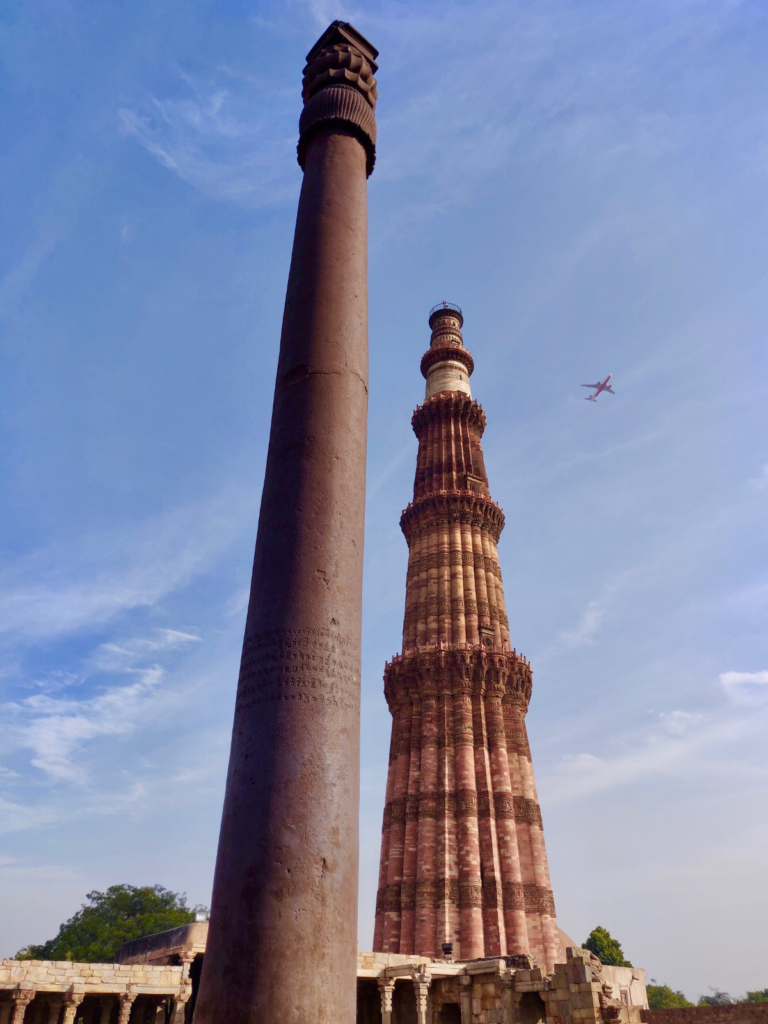
On the western end of the Quwwat Ul Islam Mosque, you will see the Iron Pillar. Play the next story here.
Most of the monuments in the QM complex are over 800 years old. But this unassuming metallic pillar is at least twice as old. This is the famous iron Pillar and it has baffled scientists for quite some time. You see, this pillar is made of pure iron, 99.7% pure. It weighs over 6000 Kilos and has been standing exposed to the elements for over 1600 years. By every yardstick, it should have crumbled into a heap of rust by now. Why has it not rusted?
There is some rust for sure, and much of it is underground. But it is ridiculously miniscule for a pillar this old.
Naturally, there are many fantastic theories. Some believe that this pillar was carved out of a meteorite, while others swear the pillar was smuggled in by aliens from a planet far far away.
The mystery was partially solved recently, when metallurgists discovered that the pillar had an outer coating - a very thin and even layer of a substance called crystalline iron-hydrogen-phosphate-hydrate - a coating that protects the pillar from corrosion. But this threw up a new set of questions - where did those ancient Indian blacksmiths learn to do this? And how did they manage to cast something so pure? We still don’t know.
Who built this pillar? And for what purpose?
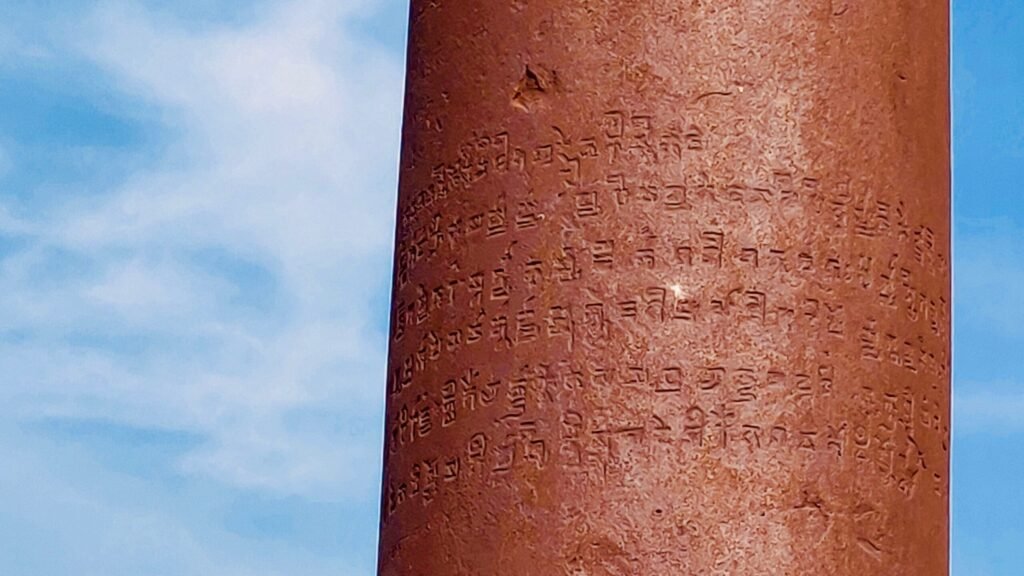
Going by the inscriptions on the pillar itself, we know that it is a Hindu monument. The oldest inscription on it dates back to 402 CE. It is composed in Sanskrit and is written in the Gupta script. It is a eulogy to a king named Chandra. Scholars have identified him as Emperor Chandragupta II, also known as Vikramaditya. He belonged to the Gupta dynasty and ruled in the late 4th century CE.
The inscription records that Emperor Chandragupta was a devotee of Lord Vishnu, the god of Protection. It goes on to say that he erected a flag post, or a standard, to Lord Vishnu, on a hill named Vishnupada. Scholars surmise that this was at a place called Udayagiri in modern-day Madhya Pradesh. It is known that Iltutmish, the Sultan who expanded this mosque, attacked the Udayagiri region in the thirteenth century. It is likely that he brought this pillar back as a trophy and had it installed here.
The tops of such pillars usually carry a sculpture of Garuda, the mythical eagle on which Lord Vishnu travels. This pillar has deep hole on top, where such a sculpture may have originally fitted.
In recent times this pillar was faced with a new problem. There is a local belief that if you are able to embrace this pillar with your arms around your back, all your wishes will come true. Naturally, most visitors stopped by to give this pillar a hug. And that threatened the pillar with more serious damage than many centuries of harsh Delhi weather. The ASI has put an end to the practice by fencing the pillar off.