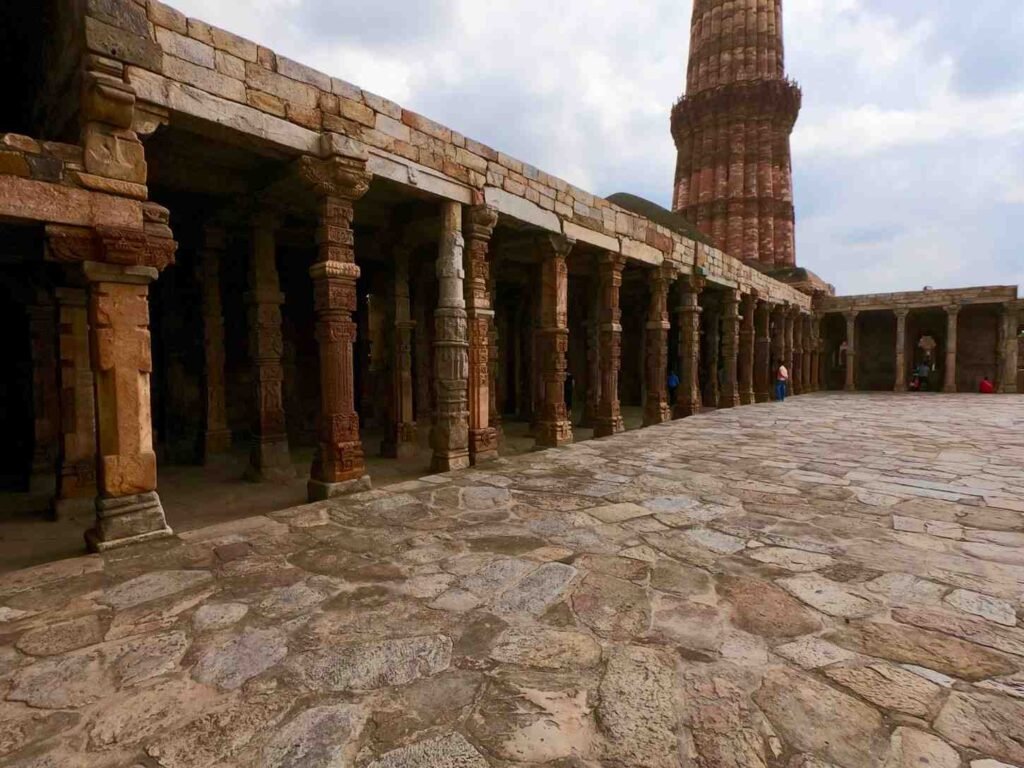
Quwwat ul Islam Mosque
This is the oldest mosque in Delhi and one of the oldest extant mosques in India. It might be the reason the Qutub complex even exists. Why was it built?
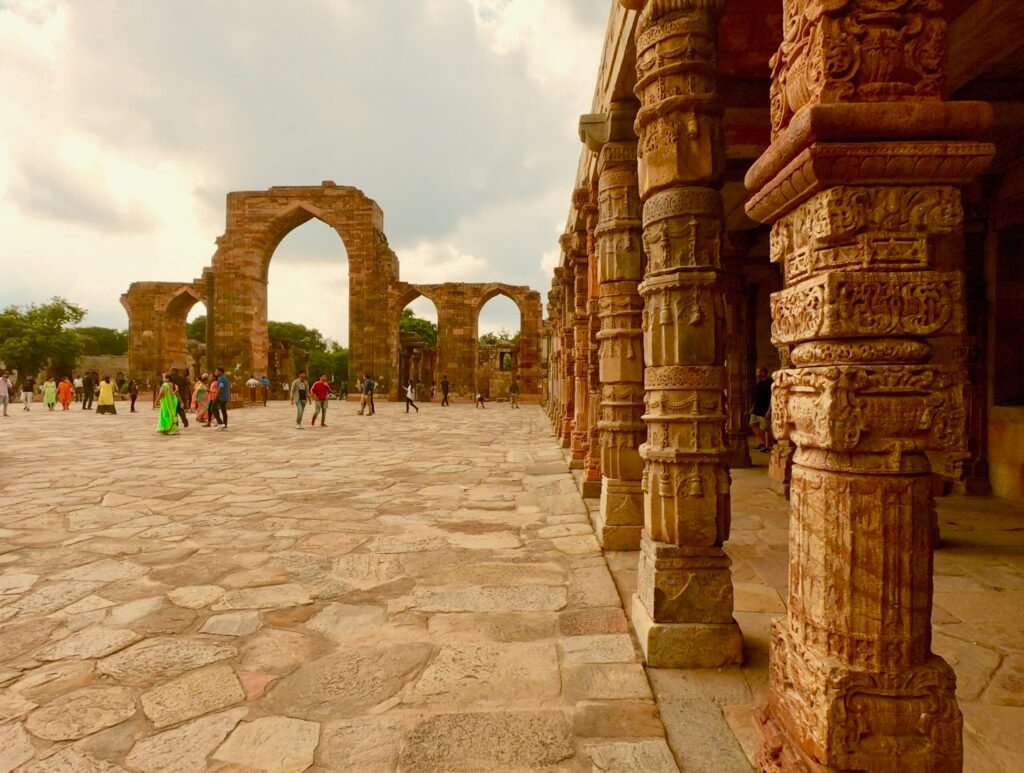
From Qutub Minar, walk to the monument located to its North, the Quwwat Ul Islam Mosque. Walk up the flight of steps into the pillared gallery of the Mosque. You can play the next story here.
The Qutub Minar complex gets its name from… well, the Qutub Minar, the tower which dominates everything else. But at its heart lies an old mosque that was probably the very reason for the existence of this complex. What you see in front of you is that mosque - the Quwwat ul islam Mosque. Completed in 1198, it is the oldest mosque in Delhi and one of the oldest Mosques surviving in India.
In 1192, Qutbuddin Aibak took control of Delhi. He and his troops were victorious invaders. But now he faced the tough task of ruling over a new people. He had to get the natives to submit to a foreign ruler, practicing an alien religion - Islam. He quickly needed to make a statement. Aibak decided to build a mosque. He built it right here, at the very site of the old Rajput fort of Quila Rai Pithora. And he built the Mosque over an older Hindu temple. AND he built it using material from 27 other Hindu and Jain temples he had razed down. A fact he recorded in an inscription on the eastern entrance to the Mosque. It was a statement, and a bold one at that.
The Mosque was named Qubbat Ul Islam, meaning ‘the Sanctuary of Islam’. Over the years, the name morphed to Quwwat Ul Islam, meaning ‘the Might of Islam’. It is an appropriate name for a monument that was built to loudly declare that the new reign was not to be messed with. The monuments in the Qutub Complex were deliberately built to overawe with their size, and intimidate with their blatant use of destroyed temple masonry.
Take a look at the pillars inside the mosque. You can still see Hindu and Jain sculptures carved on them. Since Islam does not allow the depiction of the human form, many of these sculptures were defaced or plastered over. The pillars to the right of the east entrance are believed to be from a Vishnu temple, while those on the left are from a Jain temple.
It is easy to brand this as religious intolerance today, but many historians view this more as a political necessity for that time. With this one brazen act, Aibak was able to provide his troops with a rallying point, while declaring to the locals that their earlier kings had no divine backing!
After Aibak died, his successor Iltutmish expanded the mosque. He doubled its size, bringing the Qutub Minar within the mosque complex itself. The three arches you see on the western side, were added by him. Much of the calligraphy on these arches depict verses from the Quran. Look closer and you will see straight and orderly calligraphic letters, that are common in Islamic architecture, ending in delicate flower buds - the kind of ornamentation commonly seen in Hindu architecture. This hybrid design is among the earliest examples of Indo-Islamic architecture. A style that eventually led to architectural marvels like the Taj Mahal, that came up 400 years later.

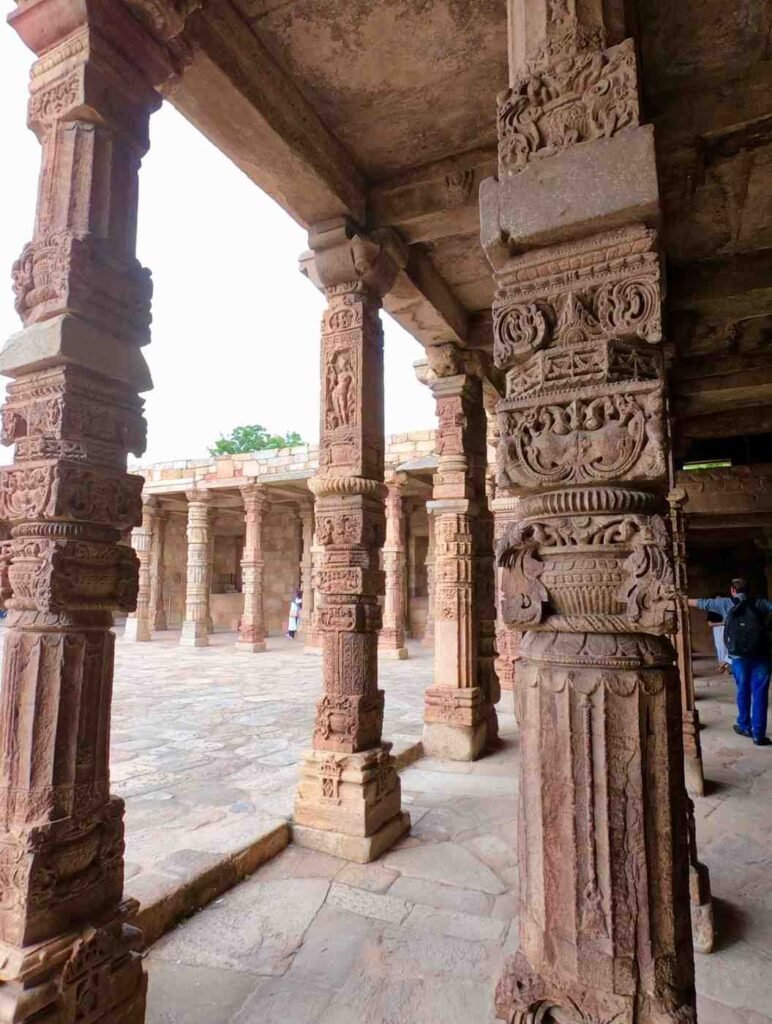
Carvings on the remaining pillars of the mosque, constructed in 1193 CE