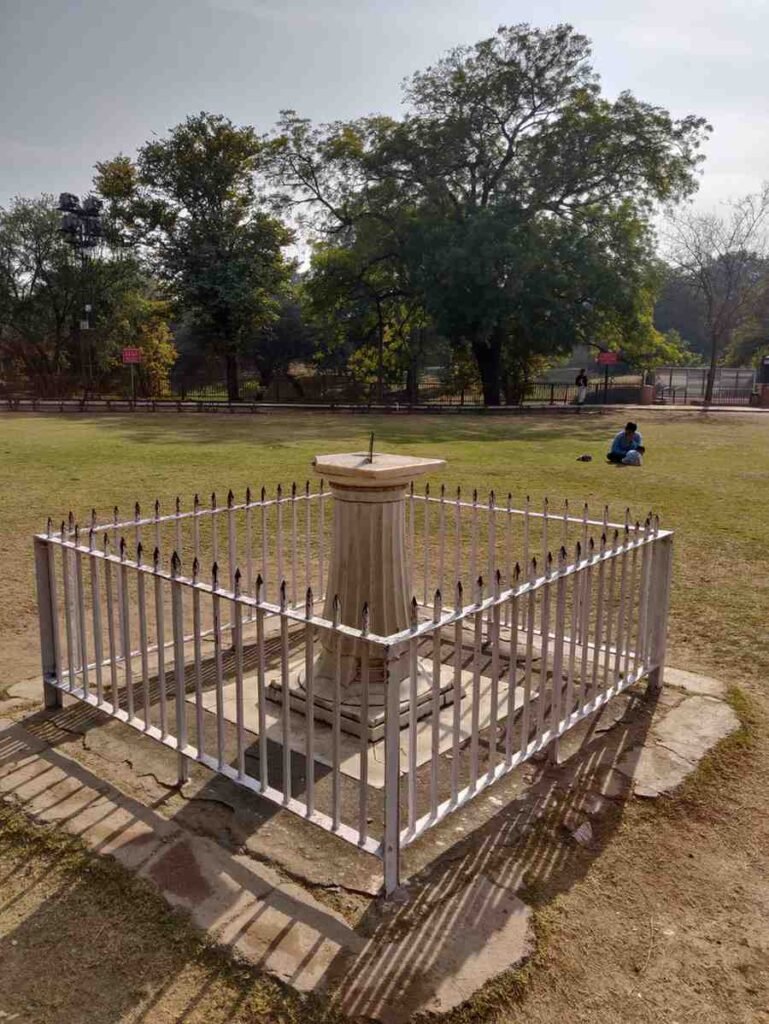
Sanderson's Sundial and Smith's Folly
This is the story of two structures that don’t really match the style of the rest of the complex – a Bengali style cupola and a European style sundial.
Turn left at the arch and follow the road until you see a signage of Smith’s Folly and Sanderson’s Sundial. You can walk up to Smith’s cupola located in one corner of the lawn and play the next story.
Can you spot a small pillared structure in one corner of this lawn? That is Smith’s cupola, also called Smith’s folly. In architecture, ‘Folly’ refers to an ornate construction that has no practical purpose. But folly also means a mistake. This structure was both.
Way back in 1368, Qutub Minar was struck by lightning. It knocked off the top storey of the monument. Firoz Shah Tughlaq, the Sultan of Delhi at that time, replaced it with 2 marble storeys. He also added an Islamic Cupola on top of it.
Then, in 1803, a devastating earthquake ravaged the whole of Northern India. The Qutub minar survived, but the cupola came crashing down. The British decided to replace the cupola, and entrusted the work to Major Robert Smith, a seasoned architect. A sum of Rs 17,000, a fortune in those days, was allotted for repairs. The new cupola was installed in 1828. Major Smith drew inspiration from the ornate canopies called Chattris, that were commonly seen in Bengal. A bit of a mis-match, shall we say, with the Islamic architecture of the Qutub Minar. Nevertheless, it was hoisted on top of the Qutub, and stayed there for the next twenty years. That’s when Lord Hardinge, the then Viceroy of India, decided that the mismatched cupola had to go. He had it brought down and placed unceremoniously in one corner of the complex. And there it sits till date, wistfully eyeing the tower that it once crowned.
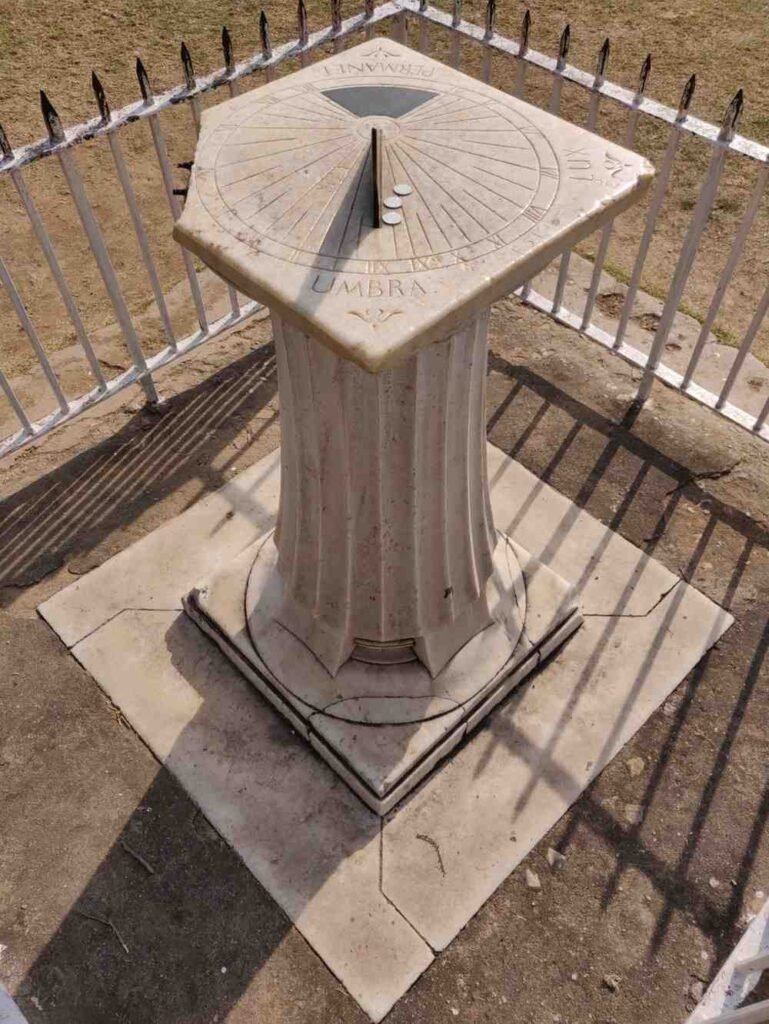
There is one more structure here, that doesn’t quite match the the style of the other monuments. Do you see a small Sundial in the centre of this lawn? It is a monument to a young archaeologist named Gordon Sanderson.
In the early 1900’s, Lt. Gordon Sanderson was part of the British army in India. He was deputed to the Archaeological Survey and assigned to excavate and restore the Qutub complex. What we see here today is largely thanks to Sanderson’s restoration work.
Sanderson was killed in battle in the First World War, at the young age of 29. His colleagues at the Archaeological survey erected this sundial in his memory in 1919. The Latin inscription on it reads Transit Umbra, Lux Permanet. It means, ‘The shadow passes, but Light is permanent’. A touching tribute to a man who brought an 800 year old monument back to life.

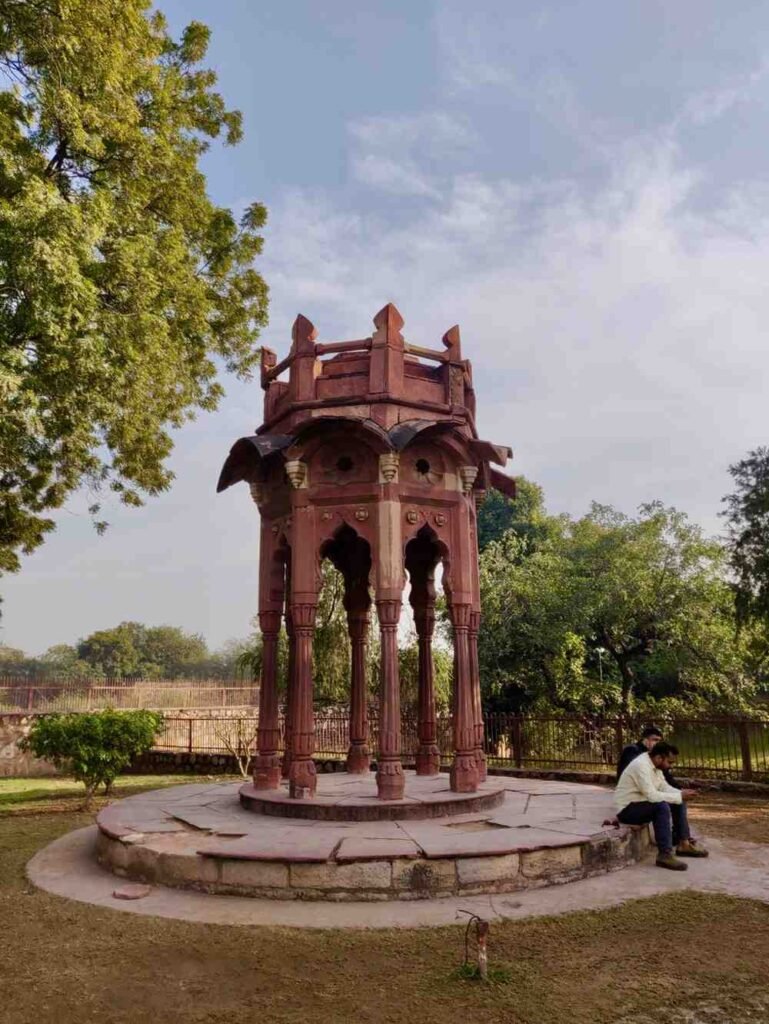
Smith's Cupola, c.1828 CE