
Introduction
Who was the first independent Muslim King of Delhi? What was Delhi like before his ascent to power? And how did his rule begin a new chapter in India’s history?
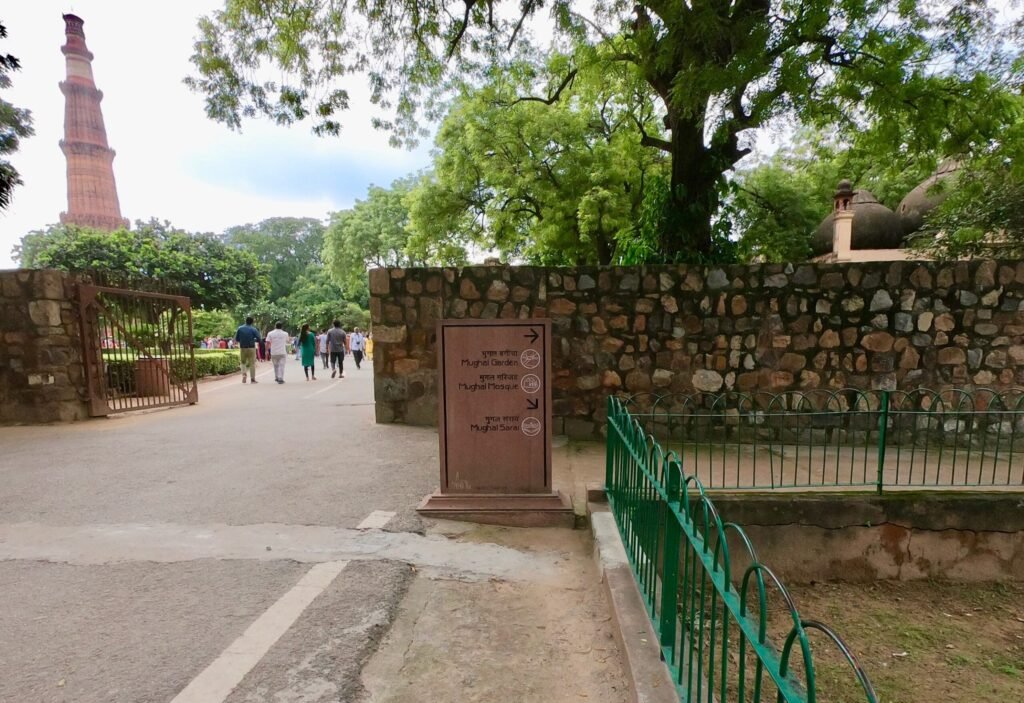
Our trail begins at the entrance of the Qutub Minar Complex. You can play the first story immediately after you go through the main entrance check points.
Hello and welcome to the Storytrails tour of the Qutub Complex. This group of monuments marks a significant turn in Delhi’s history. Events that unfolded here over 800 years ago, left a lasting impression on the entire subcontinent.
Let’s start by setting some historical context. Delhi - the city we are in right now, how old is this city?
It depends on which part of the city you’re looking at. The youngest part of the city - New Delhi, was built by the British in 1912. There is still an ‘Old Delhi’ in existence, about 15 Kms north of here. That was built in 1648 by Emperor Shahjahan, the same king who built the famous Taj Mahal. But there are even OLDER Delhis - at least 7 more. We know that the Delhi area was a prosperous settlement even as far back as the 6th century BCE.
Why were all these kings so attracted to Delhi? Well, Delhi was strategically located along the ancient East-West trade route. For invading kings from central Asia, this was an access point to the fertile Indo Gangetic plains. So, control of Delhi was always coveted.
In the last years of the 12th century, this region was ruled by a powerful Rajput ruler named Prithviraj Chauhan. He ruled over a large kingdom and had a strong army.
Around the same time, in Afghanistan, a local king named Mu’iz ad din Mohammed Ghori was becoming powerful. And he was steadily advancing eastwards - into India. He conquered parts of North-west India and Delhi was now within his reach. In 1191, he met Prithviraj Chauhan in battle at a place called Tarain, about 150 Kms North of here. Ghori’s army was thrashed and he himself was badly wounded. Ghori fled the battlefield. Prithiviraj allowed them to flee, a tactical error that would cost him dearly. Just a year later, Ghori came back again. And this time he won.
Prithviraj was captured and by most accounts, he was executed. Ghori marched into Delhi and took it easily.
After this raid, Ghori returned to his own country. He left Delhi in charge of his trusted slave, a man named Qutb ud din Aibak. In 1206, Ghori was mysteriously assassinated, and that made Qutub ud din Aibak the first independent Muslim king of Delhi. It was he who laid the foundation for this monument - the Qutub Minar.
This battle for Delhi, was a decisive turning point in Indian History. It brought in Turkic, Muslim rulers, who, unlike the earlier invaders, did not just plunder and retreat, but stayed back and made this their home. Delhi would be ruled by Muslim kings for nearly 700 years after this. And this reflects in the local art, architecture, languages and food, to this day.
