
Ghaskol Buddhist Monastery
1800 years ago, this quiet archaeological site was a bustling Buddhist monastery, home to monks who lived and studied here.
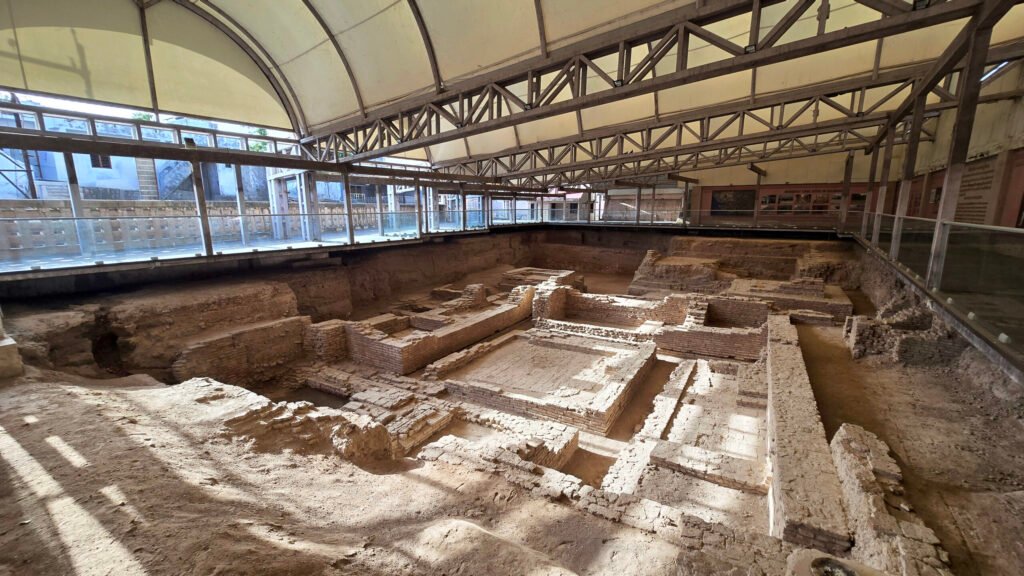
From Sheetala Mata temple, walk back to the main lane, take a right and then another right at Ghaskol gate about 200 m away, to reach the Buddhist Monastery ruins.
This is a quiet archaeological site today, but 1800 years ago, it was a bustling Buddhist monastery, home to monks who lived and studied here.
It was such a prominent Buddhist center that the famous Chinese monk, Xuanzang, visited the site and wrote about it in the 7th century. But after that, the monastery gradually faded from memory. It was only in 2006 that archaeologists found these remains and made the connection with the Chinese monk’s writings.
But how did a monastery come to exist here? It is believed that Buddhism reached Gujarat after the death of Buddha in the 5th century BCE. But it gained real momentum in the 3rd century BCE, when the Mauryan emperor Ashoka took it upon himself to spread the faith across his territories. He left inscriptions on rocks and pillars across the subcontinent expressing his belief in Buddhist ideals. One such edict is in Junagadh, also in Gujarat, telling us that Buddhism was active in these parts in his time.
After the Mauryans, this region was ruled by several Hindu dynasties. They were tolerant patrons of different religions. So temples and monasteries flourished side by side in prosperous trading towns like Vadnagar. And it was this religious harmony that caught the attention of Xuanzang. In 640 CE, on his epic journey across India, he wrote a glowing account of a place he called ‘O-nan-to-pu-lo’. Historians today identify it as Anandapura, the ancient name of Vadnagar.
Xuanzang describes a prosperous city with about 10 Buddhist monasteries and nearly a 1000 monks. He identifies them as followers of the Hinayana tradition. He also notes that the city had many Hindu temples, and followers of different faiths lived together amicably.
These remains at Ghaskol may have been one of those monasteries he described. When archaeologists dug up this place, they found that this monastery was built in the shape of a swastika! The swastika is an auspicious symbol in Buddhism, Hinduism, and Jainism. It symbolises well-being and harmony. It is often associated with the Buddha and is seen on his statues, on his chest or the soles of his feet.
Set within this swastika-shaped layout was a central courtyard, with small living quarters arranged along its sides. It probably housed a dozen resident monks. The swastika design ensured better access to natural light and ventilation for these spaces.
Excavations also revealed a red sandstone head of the Buddha and pottery inscribed in the Brahmi script. Nearby, along the banks of Sharmishtha Lake, archaeologists uncovered the remains of a large brick stupa dating to the early centuries of the Common Era. Together, these finds confirm what Xuanzang recorded nearly 14 centuries ago; that Vadnagar was once an active Buddhist centre.
But over time, Buddhism declined in western India. By around the 8th century, many monasteries like this one had been abandoned.

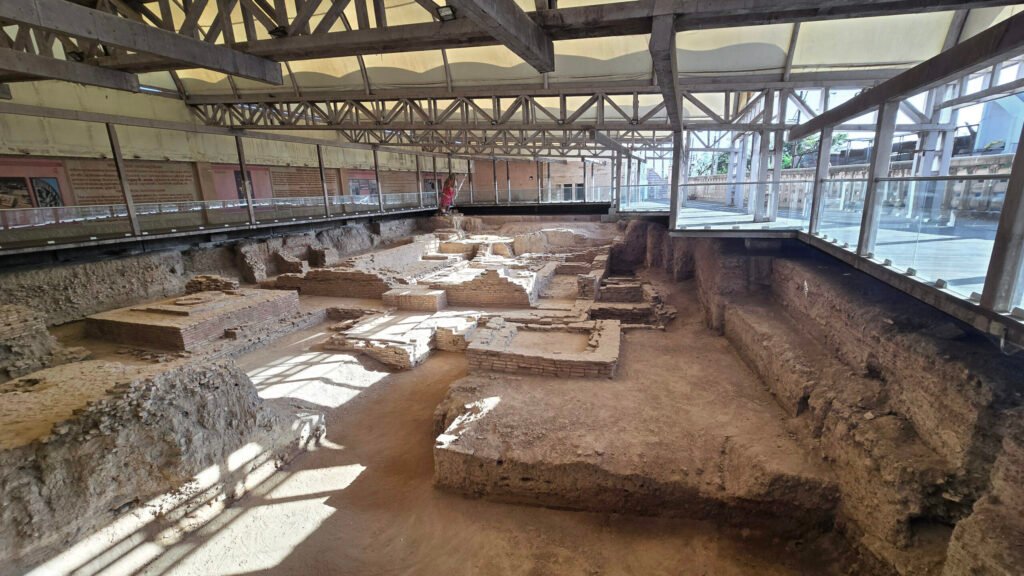
Buddhist Monastery
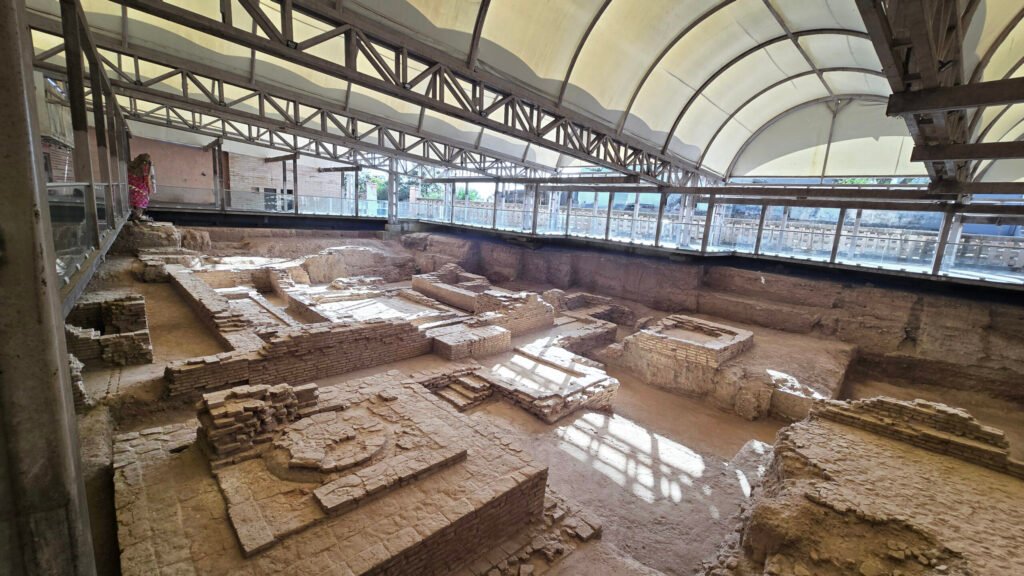
Buddhist Monastery
You Might Also Be Interested In
Explore More
Understanding Xuanzang | Haraprasad Ray
Who was Xuanzang and what do we know about him?
When Gujarat took refuge in Buddha | The Times of India
Gujarat's Buddhist heritage sites.