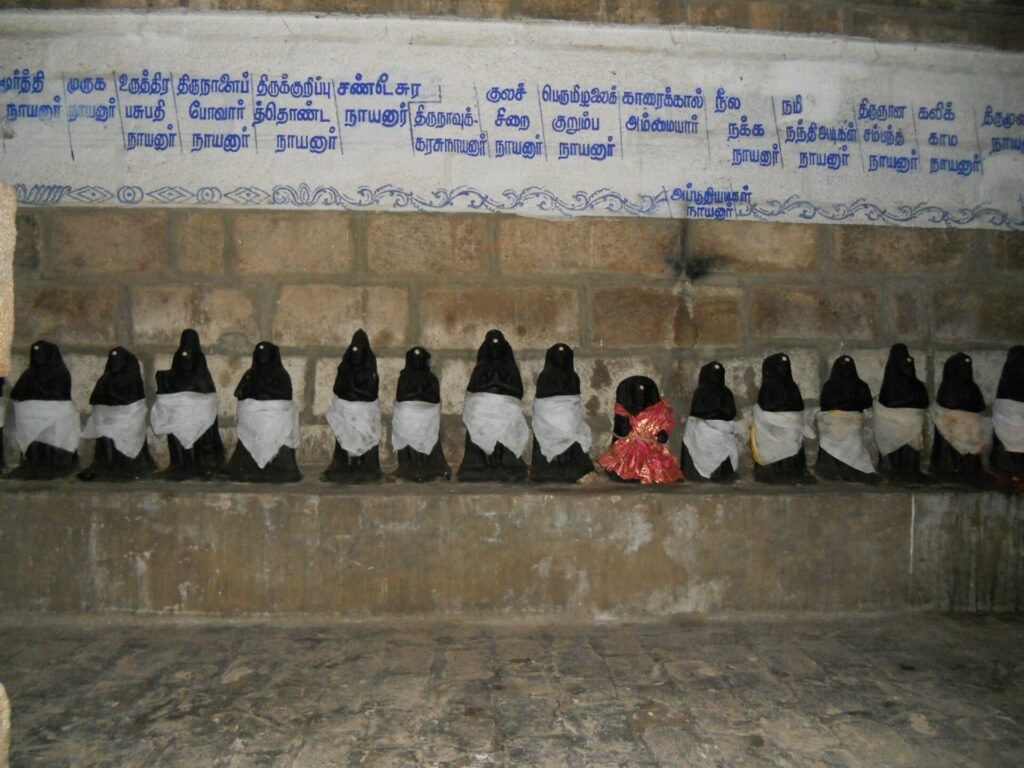
Tirumangai Azhwar
The story of Tirumangai Azhwar - one of the most influential Vaishnavite saints.
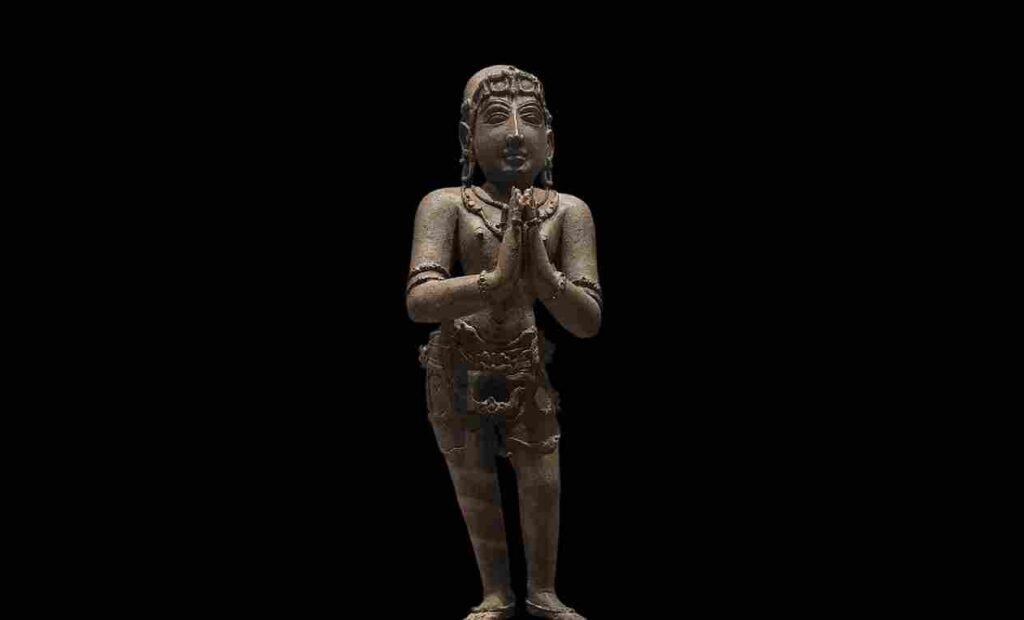
Look for a showcase displaying the sculptures of the Azhwars. Look for the exhibit marked 'Tirumangai Azhwar'. Play this story there.
The sculptures you see here represent the Azhwars - the 12 Tamil poet saints who lived between the 7th and 9th centuries CE and were great devotees of Lord Vishnu. This was a time when Jainism and Buddhism were growing fast in popularity in South India. Around that time, a group of Hindu poet saints from Tamil Nadu started composing and singing devotional songs simplifying Hinduism and making it more relatable to its followers. Spearheading this movement was a group of 63 poets called the Nayanmars, who were great devotees of Shiva and 12 Tamil poet-saints called Azhwars, who were great devotees of Vishnu. The Azhwars wrote prolifically on Vishnu. Their religious hymns and verses are called Divya Prabhandams and are sung in temples even today. All twelve of the Azhwars are historical characters, but over time, their stories have acquired an air of divinity.
Take the example of Tirumangai Azhwar – his statue is the biggest one here. Historians believe that he may have been a contemporary of the Pallava King Nandi Varman, who ruled in the 8th century CE. Tirumangai travelled all over India and composed 1,361 of the 4,000 Divya Prabandham verses, making him the single most important Azhwar.
“Never ask a saint about his antecedents,” so goes a Tamil proverb. It means that even a holy saint might have had an unsavoury past. The story of Tirumangai Azhwar illustrates this well.
Tirumangai Azhwar was born to a family of Shiva worshippers and was named Neelan. When he grew up, he became a commander in the Chola army and distinguished himself in many battles. The reigning Chola king was delighted and granted him a huge piece of land in a province named Tirumangai.
Legend has it that Tirumangai fell in love with a beautiful maiden named Kumudavalli . She agreed to his marriage proposal on two conditions - that he should become a Vaishnavite and that he should feed a thousand poor people everyday. He readily agreed and they were married.
Converting to Vaishnavism was the easy part. But feeding a thousand people everyday was an expensive proposition! Soon, Tirumangai’s treasury was exhausted. Yet, he could not renege on the promise made to his wife. In desperation, he decided he would rob the rich by night and feed the poor by day. He knew this was morally wrong, but it worked and he continued for a long time. He even donated money for revamping the famous Srirangam temple!
Finally, Vishnu and his consort, Lakshmi decided to teach him a lesson. One night, they wore their most opulent jewellery, and walked past Tirumangai’s house. As expected, Tirumangai promptly robbed them and bundled all their jewels in a piece of cloth. But when he tried to lift the bundle, he just couldn’t! It was too heavy. He soon realised who was behind this miracle. The message was clear: he had to give up his violent ways and atone for sins. Overnight, he became a prolific poet. He made it his life’s mission to travel all over the country and sing praises of Lord Vishnu, thus becoming the most famous of the 12 Azhwars.

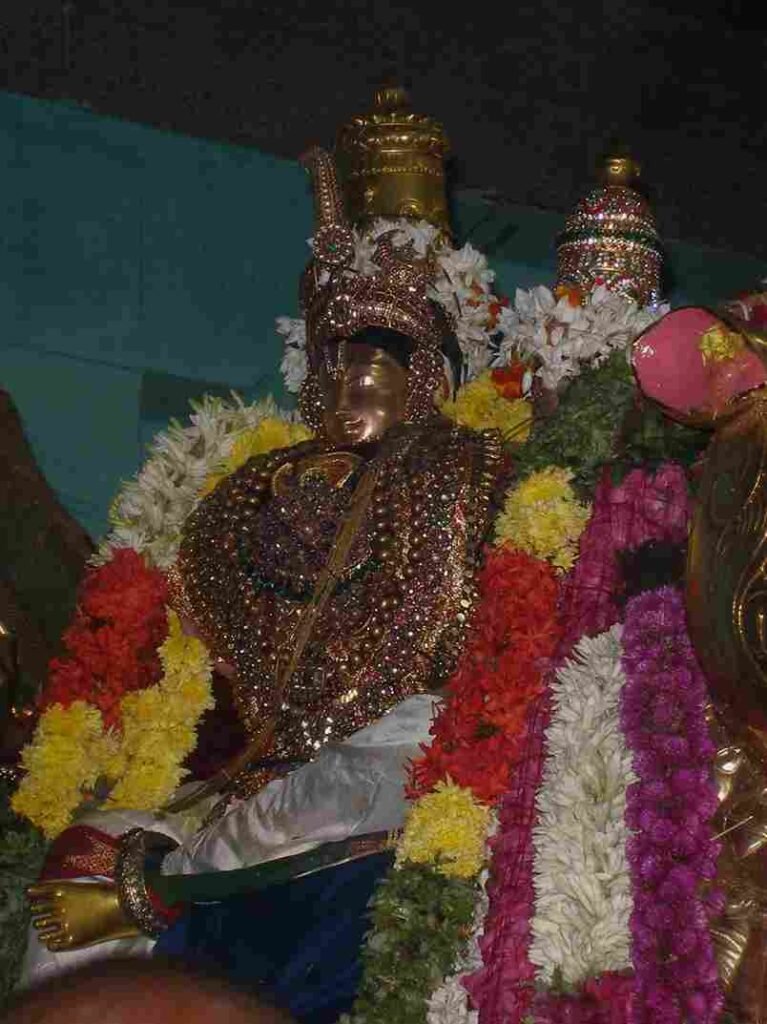
Tirumangai Azhwar, seated on a gold-plated hamsa vahana (swan mount), along with his wife, Kumudhavalli Thaayar, Thirunaangur, TN
Wikipedia. Photo by gupthasp