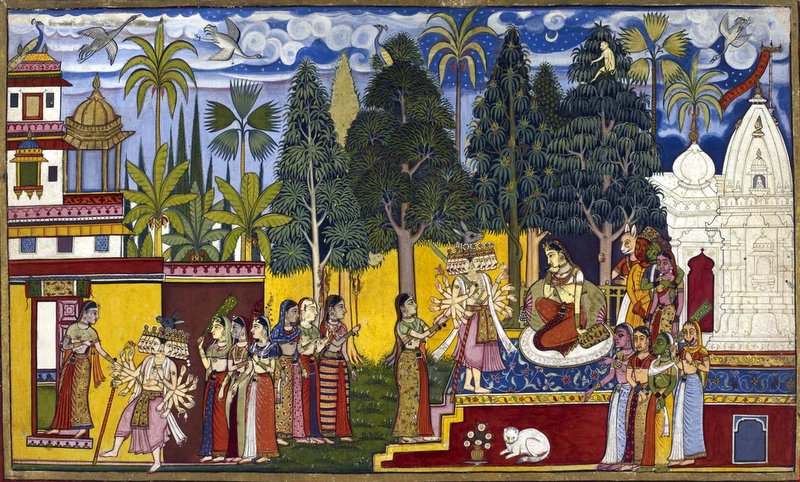
Rama - the ideal man
The story of Rama explores the values of family and righteousness.
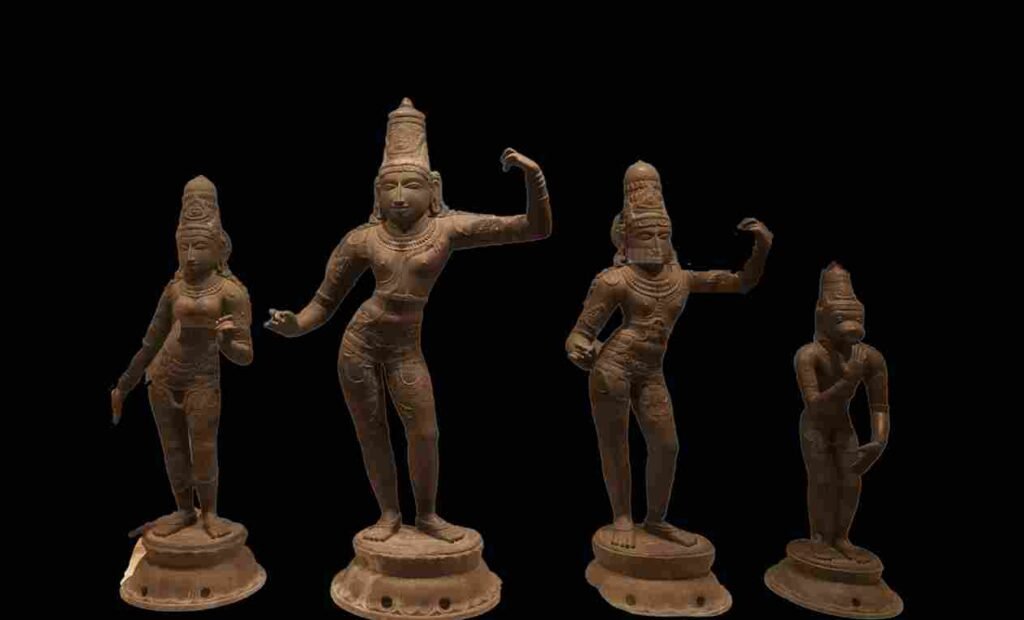
Look for a showcase housing the sculptures of Sita, Rama, Lakshmana and Hanuman. Play this story there.
The four figures in front of you are the main characters of the great Indian epic Ramayana. Rama was the seventh avatar or incarnation of Vishnu, the preserver of the universe. Like other incarnations of Vishnu, Rama too was born on earth to set right all things wrong and to restore the balance of the world.
The tallest sculpture is Rama. Flanking him are Sita, his wife, and Lakshmana, his half-brother. The monkey-god you see is Hanuman. He comes a little later in the epic tale but is essential to the story of Ramayana because of his sheer devotion to Rama and Sita. Both Rama and Lakshmana are magnificent archers and are hence usually represented holding bows.
Ramayana, or the story of Rama, has several versions. But the basic story remains the same in most of them. Rama was born in the royal family of Ayodhya to King Dasharatha and his wife, Queen Kaushalya. He grew up to be a fine prince, beloved to all in the kingdom. But just as he was all set to be crowned king, tragedy struck. The king had two other wives and three sons born to them – Rama’s half brothers - Lakshmana, Shatrughna and Bharata. On the eve of the coronation, Dasharatha’s youngest wife, Kaikeyi, redeemed an old promise and demanded his banishment from the kingdom for 14 years. This she did so that her son, Bharata could rule. And so Rama set off on his exile accompanied by his half-brother Lakshmana, and his wife Sita, who refused to let him go alone.
What follows is a series of hardships and misfortunes, as well as some beautiful moments in the forest - all of which are recounted in rich detail in the epic. The story weighs up notions of right and wrong, and explores the ideas of family and morality. Across India, Rama is seen to possess all the attributes of an ideal man - he is seen as the ideal king, warrior, son, brother, and husband. The story ends with the victorious return of the trio to Ayodhya. It is the day of this heroic return that people in North India celebrate as Diwali, the festival of lights.
Rama is venerated across India. And while references to Rama as an avatar of Vishnu are found in ancient Tamil literature too, it was only by the 12th century CE that he became a household name in Tamil speaking regions. The Tamil version of the Ramayana, the Kamba Ramayanam, is believed to have been compiled by around the 12th century. It was around that time that the Cholas, who created the sculpture you see here, used symbols typically associated with Vishnu on statues of Rama too.