
Chandikeswara
The story of the poet-saint who is considered the sentinel of all Shiva temples.
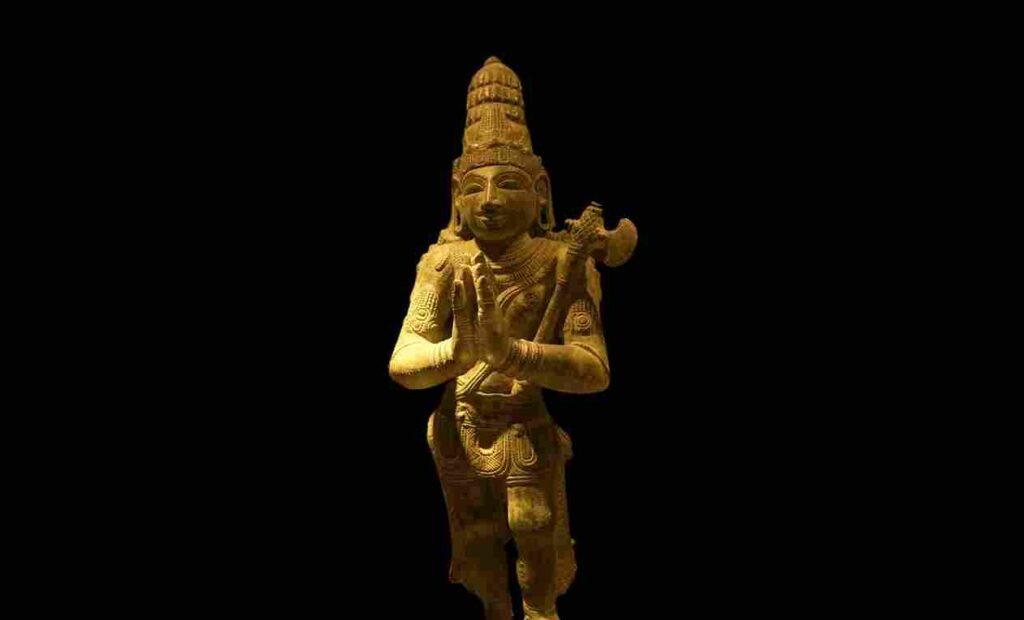
The sculpture you see here is of Chandikeswara, one of the 63 Nayanmars, or poet-saints who devoted their lives to promoting the worship of Shiva between the 6th and 8th centuries.
In almost every South Indian Shiva temple you will find a shrine to Chandikeswara. It is customary for all devotees to visit his shrine after they have finished all other prayers. At his shrine, they gently clap their hands or snap their fingers to attract his attention. It is to symbolically convey that their hands are empty, and that they are not taking away any temple property. The 12th century Tamil epic Periyapuranam tells us the story behind this custom.
There was once a young cowherd named Vichaara Sharma, who was an ardent devotee of Shiva. Everyday, after he let the cows loose in the green pastures, he would make a Shiva lingam, an icon of Shiva out of sand, and worship it with great devotion. Then he would pour some milk over it, giving it a purificatory bath. One day, a villager saw this and complained that Vichaara was wasting milk that belonged to the village. Vichara`s father was furious. He quietly went into the pastures to check and saw Vichara pouring fresh, creamy milk over the lingam. He lashed out at his son, and then at the lingam, kicking it over with his feet. Vichaara was horrified. In a fit of rage, he threw his herding stick at his father. But such was his fury that the stick turned into an axe and cut his father`s legs.
Shiva, who was watching this scene from the heavens, was moved by Vichaara’s devotion. He stepped in, restored the father’s legs and then offered Vichaara a divine assignment. He gave Vichaara a new title, Chandikeswara, and made him the sentinel of all Shiva temples. Chandikeswara is said to keep watch over what people bring in and take out of the temple.
And that’s the legend of Chandikeswara, one of the Nayanmars who is believed to have lived in the town of Seynaloor on the banks of the river Kaveri. In sculptures, Chandikeswara is typically portrayed seated in a relaxed pose, his right leg hanging down and left leg resting on the pedestal. Nayanmars were usually depicted with the objects associated with their legends, and Chandikeswara is commonly shown holding an axe.
This idol was cast around the 11th century, at the height of the Imperial Chola rule. Notice the long fingers with perfect nails and the locks of curly hair. Notice too the intricate jewellery of that era: the ornaments around his neck, the waist band, the sacred thread and the huge earrings.
