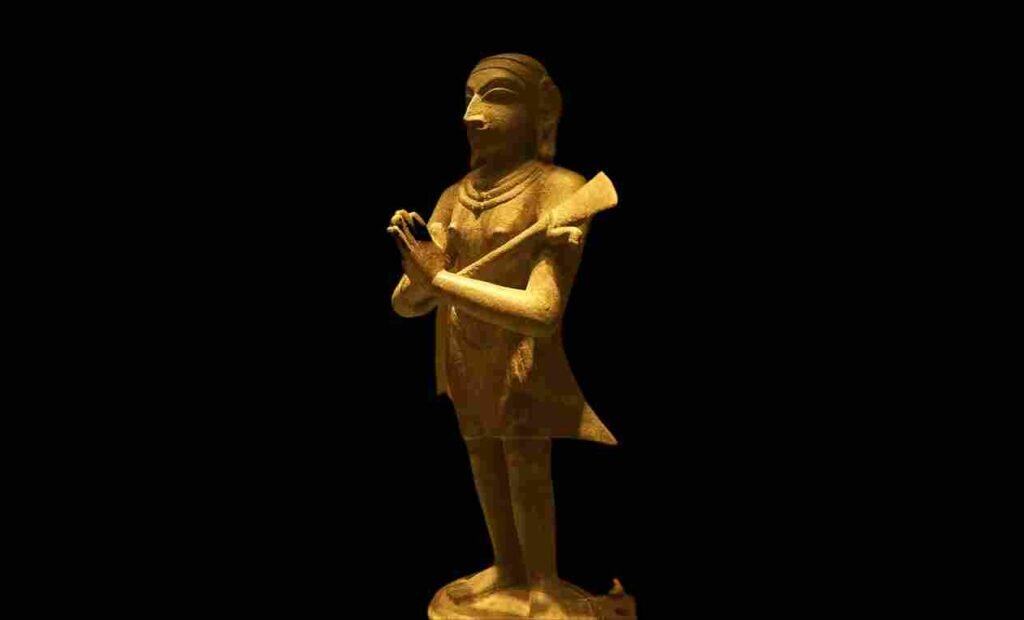
Appar
The story of the Jain monk who became one of the most influential Shaivite saints.
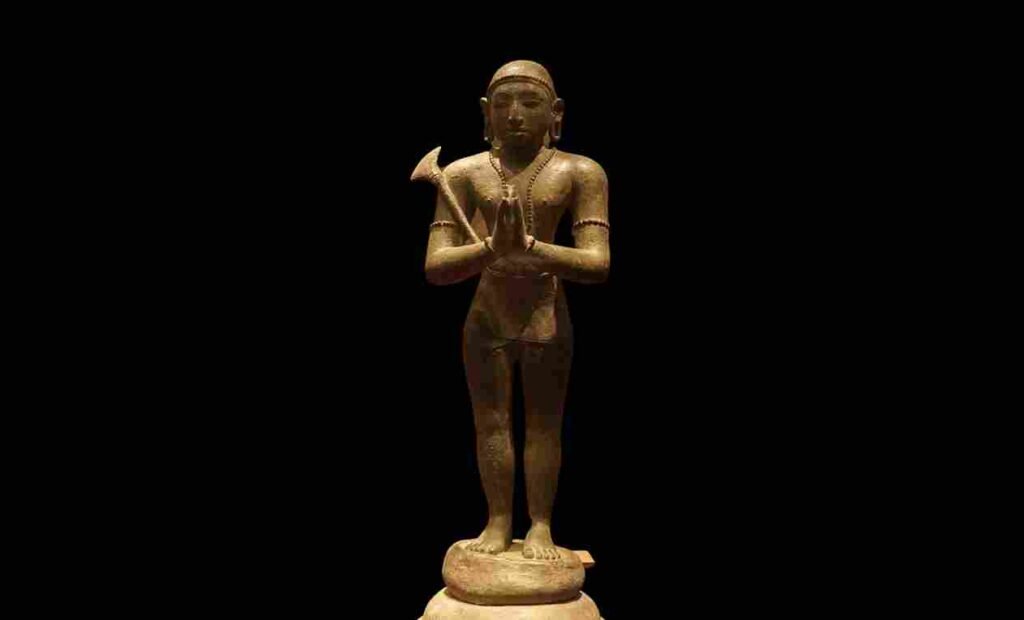
Look for a sculpture labelled 'Appar'. Play this story there.
Can you spot a statue of a man carrying a garden hoe in his right hand? That is Appar, one of the 63 Nayanmars, or poet-saints who popularised Shaivism. He is believed to have lived between 570 and 670 CE and is considered one of the most influential Nayanmars.
Appar lost his parents early and was raised by his elder sister. She was a staunch devotee of Shiva and instilled the same faith in Appar. But this was a time when Jainism was very popular and influential in the region. Appar too was influenced by the faith and willingly embraced it. Over time, he mastered Jain philosophy and became the respected head of a Jain monastery.
Story goes that one day, Appar fell terribly ill. The Jain monks fervently prayed to bring him relief but to no avail. Finally, Appar, though in great agony, somehow managed to reach his sister’s house. She immediately took him to a Shiva temple. That’s where Appar spontaneously burst into a song promising to devote himself to Shiva if he was relieved of his illness. Miraculously, Appar was healed. And he stayed true to his promise. He travelled to Shiva temples across south India and made it his life’s work to clear temple paths of vegetation for the comfort of other devotees. Over his lifetime, he is said to have composed as many as 4900 songs in praise of Shiva. Only a few hundreds have survived though.
Meanwhile, the Jains were unhappy about losing a prominent member of their community. They complained about him to the king. The king, who himself had converted from Saivism to Jainism, ordered that Appar be punished severely. So Appar was poisoned, immersed in water and even thrown under a charging elephant. And yet, Appar survived it all. The king was impressed. Not only did he stop persecuting Appar, he himself converted back to Shaivism. And Appar went on to become a widely venerated Bhakti saint.
While some parts of this story may be attributed to folklore, historians do know that Appar’s lifetime coincided with the reign of the powerful Pallava king Mahendra Varman-I. It is known that Mahendra Varman converted from Saivism to Jainism and back again to Saivism. And many historians believe that Appar was a trigger in Mahendra Varman’s reconversion.
How do experts identify a sculpture of Appar? This 12th century sculpture of Appar shows him wearing the rudraksha beads on his head and arms - a typically Shaivite custom. The shaven head points to his time as a monk. The most visible clue is the garden hoe that he is depicted carrying - the tool he used to clear temple paths.