
The Marathas of Thanjavur
What connection did the Marathas have with South India?
This free audio tour is brought to you thanks to the generous support of Pando. Visit pando.ai to learn more about them.
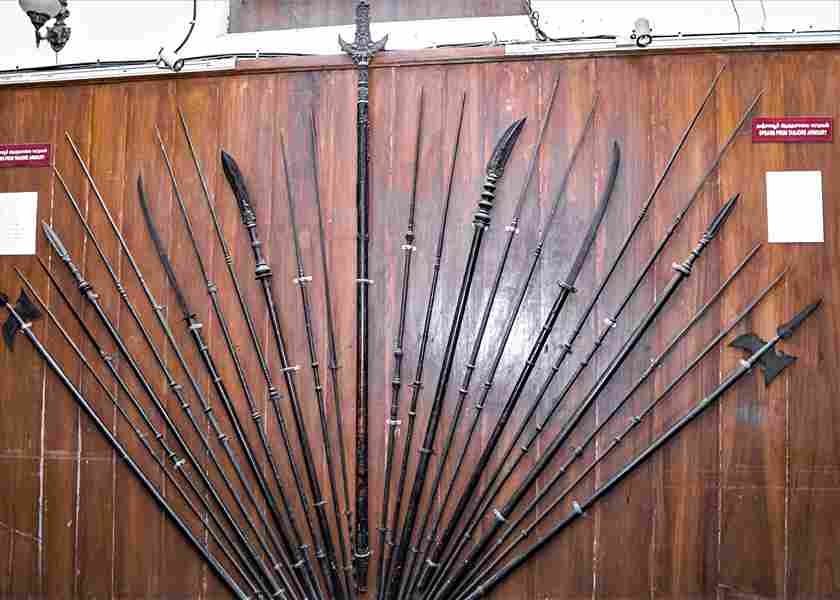
In many cities of India, you would come across the South Indian Maharashtrian Association. Oddly enough, Maharashtra is a state in western India, so who exactly is represented by this association? It is a community of over 200,000 people who hail from the southern district of Thanjavur in Tamil Nadu, but speak a unique dialect of Marathi dotted with Tamil, Kannada, and Telugu words. This community exists because of a historical event in the 17th century. The spears and lances in this showcase tell us the story of the Marathas of Thanjavur.
Thanjavur is a fertile region on the Kaveri river delta. During the 16th and 17th centuries, this region was ruled by the Nayak dynasty. In 1673, the last Nayak king of Thanjavur was treacherously killed by his own nephew. Desperate for help, the slain king’s son appealed to the Sultan of neighbouring Bijapur for help. The Bijapur Sultan saw this as an opportunity to extend his influence in the South. He immediately sent his general to help the Nayak prince. This general was a man named Venkoji Bhonsle.
Venkoji Bhonsle marched to Thanjavur and successfully defeated the Nayaks. But then, he decided to keep Thanjavur for himself. He broke away from the Sultan of Bijapur and quickly asserted himself as an independent king of Thanjavur. And that was the beginning of the Maratha reign in Thanjavur. Wait, did we say Maratha?
Yes. Venkoji Bhonsle’s half-brother was none other than Chatrapati Shivaji himself, the man who created the Maratha Empire. Before Shivaji established the Maratha empire, his father, Shahaji Bhosle, and half- brother, Venkoji, served as generals of the Bijapur Sultan.
But the Marathas of Thanjavur were not allied with the Maratha kingdom of Sivaji. In fact, Sivaji was more of a threat than an ally to the Thanjavur Marathas. They were also under constant threat from the kings of Madurai, Mysore and Arcot. So, the Marathas of Thanjavur were in a constant state of military alert in those times. They had a huge armoury, and you can see an interesting collection of their arms in this gallery.
This new kingdom welcomed many Maharashtrians as soldiers, scholars and professionals. The Maratha kings were wise enough not to forcibly impose their native culture. Instead, they chose to blend in and create a unique subculture that was a mix of both. And that is how the south Indian Maharastrians came to be.
The Thanjavur Marathas patronised scholars and promoted music and art. Many great south Indian musicians gained fame in the Thanjavur court. They lovingly nurtured the ancient Chola temple for Brihadeeswara and embellished it. To this day, a member of the erstwhile royal family continues to be a temple trustee. Venkoji’s descendants continued to rule Thanjavur till 1855, when the British annexed Thanjavur.

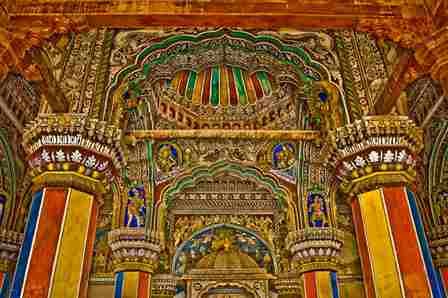
Darbar Hall, Thanjavur Maratha Palace, Thanjavur (Tanjore)
Wikipedia. Photo by Kalanidhi