
The birth of Buddha
This is the story of Buddha's birth as depicted in a sculpture called Maya's dream.
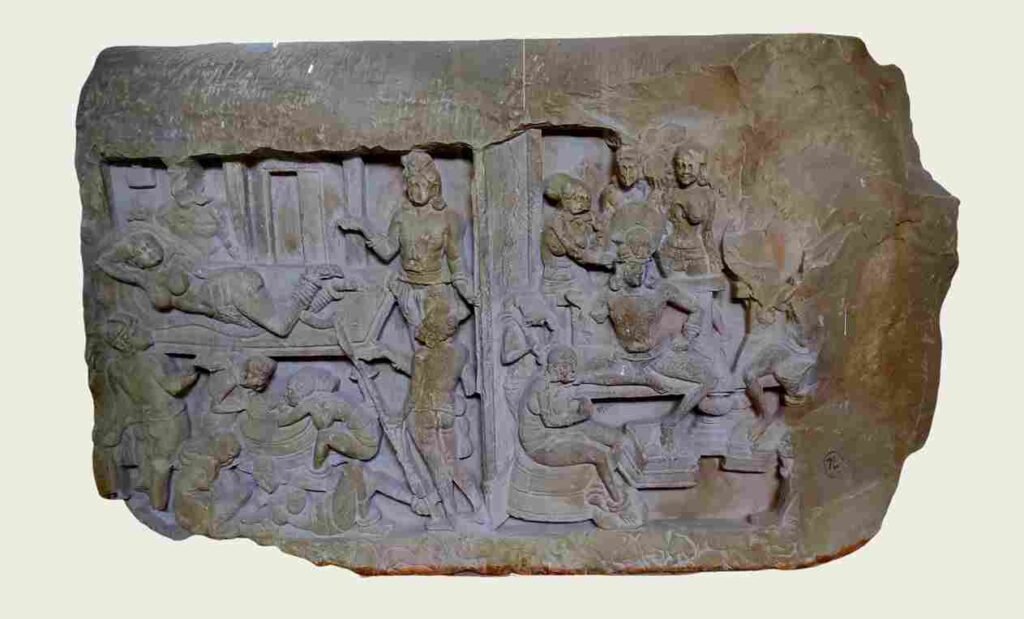
From the Amaravati Gallery entrance, turn right and walk to the end of the room. Look for a sculpture marked 'Mayadevi's dream and its interpretation' in the second-last aisle. Play this story there.
Look for the panel called Maya’s dream. It tells the story of Buddha’s birth.
A long time ago, in the 6th century BCE, king Suddhodhana and his wife Queen Maya lived in modern-day Nepal. They ruled over the tribe of Shakyas.
The royal couple was childless and that weighed heavily on their minds. One night, Maya had a strange dream. In her dream she saw a white elephant enter her womb. The wise men in the palace interpreted this to mean that Maya would soon be blessed with a son.
They also prophesied that he would grow up to be either a great king or a great monk.
In the right half of the panel you will see a man holding up his hand, indicating the two possibilities. On the left half of the panel, you can see Maya reclining on a bed, surrounded by her attendants.
As predicted, a baby boy was born and he was named Siddhartha. The king made sure that Siddhartha lived a protected life, full of luxury. Like any other king, he wanted his son to be a great king. So he raised him without any exposure to suffering. But in his 29th year, when Siddhartha went out for a ride on his chariot, he was deeply saddened by all the suffering he saw around him. That very night he fled from the palace. He travelled for years in search of a solution for human suffering. One day, as he meditated under a Pipal tree in Bodh Gaya in Bihar, he found the answers he had been seeking desperately. From then on, he was called Buddha, meaning the ‘enlightened one’.
For the next 45 years, Buddha is said to have walked through much of North India, talking to people about his philosophy. After his passing, his teachings were kept alive by small groups of monks.
Things changed dramatically in the 3rd century BCE. That’s when Emperor Ashoka converted to Buddhism, and started promoting the religion actively. His son and daughter, Mahinda and Sangamitra, are believed to have travelled to Sri Lanka to plant the seeds of Buddhism there. Over time, Buddhism took root in countries as far as Burma, Nepal, Tibet, China and Japan.
In India, Buddhism grew at a tremendous pace until about the 6th century CE. However, between the 6th and 10th century CE, a Hindu renaissance called the Bhakti movement nudged out Buddhism from India.
Today, in India, the land of its birth, there are very few practicing Buddhists. But world over, there are over 500 million people who follow Buddhism.

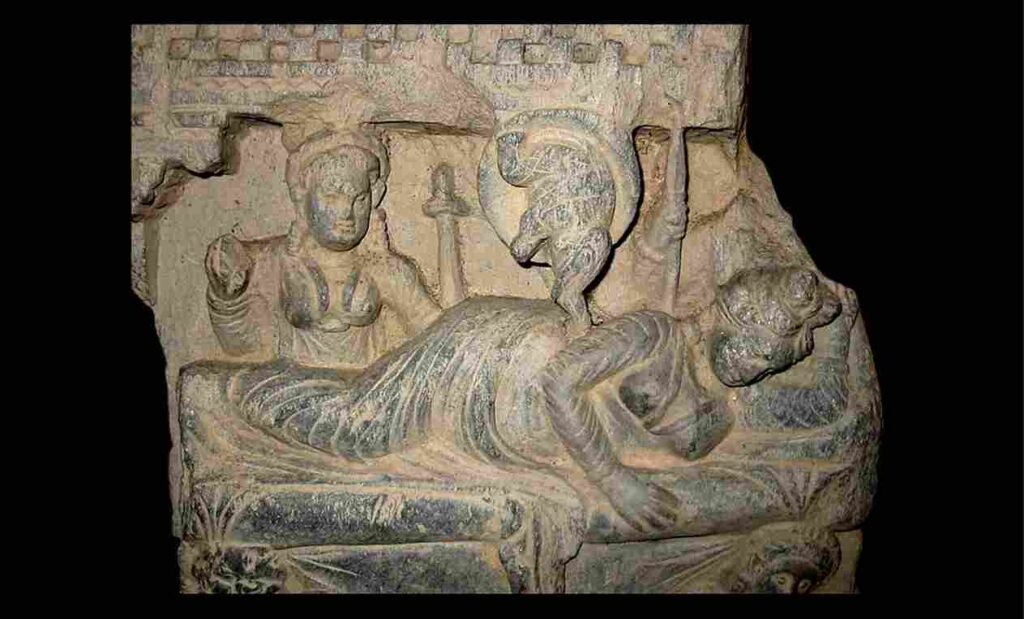
Queen Maya dreaming of the white elephant, depicted in the Gandhara style, 2nd–3rd century CE.
Wikipedia