A battle that changed the course of religious history
This is the story of how Buddhism spread in India.
Take the stairs to the first floor, turn left and stop at the first bay, the Kalinga bay. Play this story there.
Over 2000 years ago, in the year 260 BCE, a fierce battle was fought on the plains of Kalinga. Kalinga is a part of present-day Odisha. The battle that was fought there changed the course of religious history, not just in India but in Sri Lanka, and then the whole of southeast asia, China, Korea and Japan. It led to the adoption of Buddhism on a massive scale in India after which it took root in other parts of the world.
In those days, Kalinga was a prosperous independent state. To its north lay the kingdom of the Mauryas, a dynasty that was expanding aggressively. Their empire covered almost the entire subcontinent. The king of Mauryas was Ashoka. He was determined to annex Kalinga. Ashoka won the battle, but at the cost of thousands of soldiers. It is said that he walked the battlefield after his victory, and was horrified by what he saw. And just like that, he decided to lay down his weapons. He took it upon himself to spread Buddhism, a religion that preached the principle of ahimsa or non violence. Buddhism was still in its early days but it had now gotten itself a powerful ambassador.
Ashoka’s way of spreading Buddhism was to inscribe Buddha’s teachings on pillars and stone slabs. These are called the Ashokan edicts and they are found scattered over large parts of India. You can see images of Ashokan pillars and edicts in the adjoining bay. They are among the earliest known stone sculptural remains from India. Ashoka also built shrines and monasteries to help spread Buddhism.
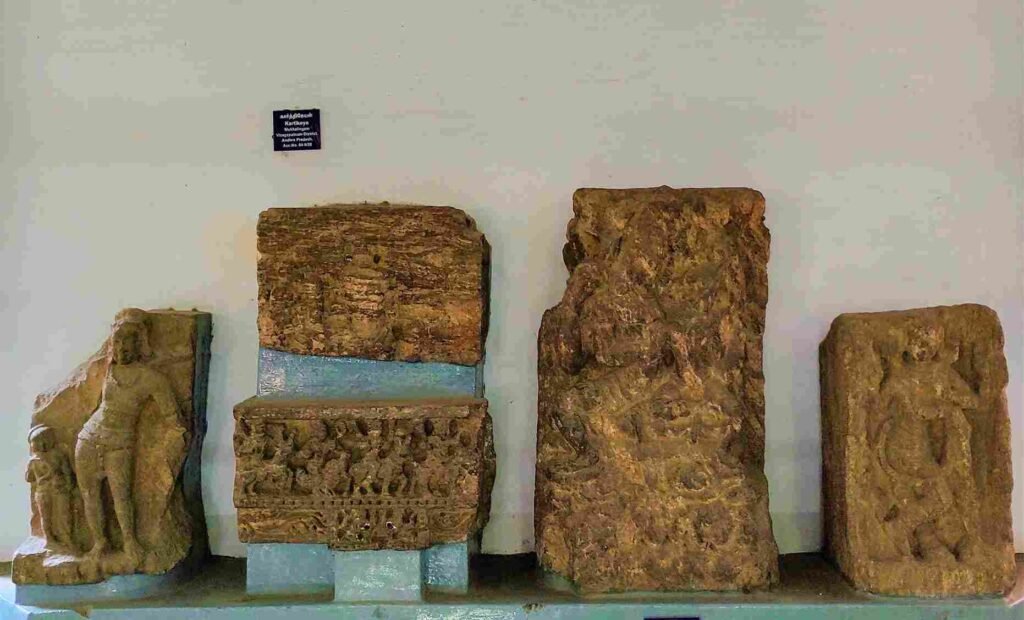
The artwork in these monuments was largely symbolic, with motifs like the wheel of life and footprints of Buddha. Back then, it was considered improper to depict the Buddha himself, and so there is no known image of Buddha sculpted during this period.
This is the style of art you will largely see in the adjoining gallery. We’ll get there shortly. It is called the Amaravati school of art and it is the oldest style of Buddhist art in the world, dating back to the 2nd century BCE.
This free audio tour is brought to you thanks to the generous support of Pando. Visit pando.ai to learn more about them.

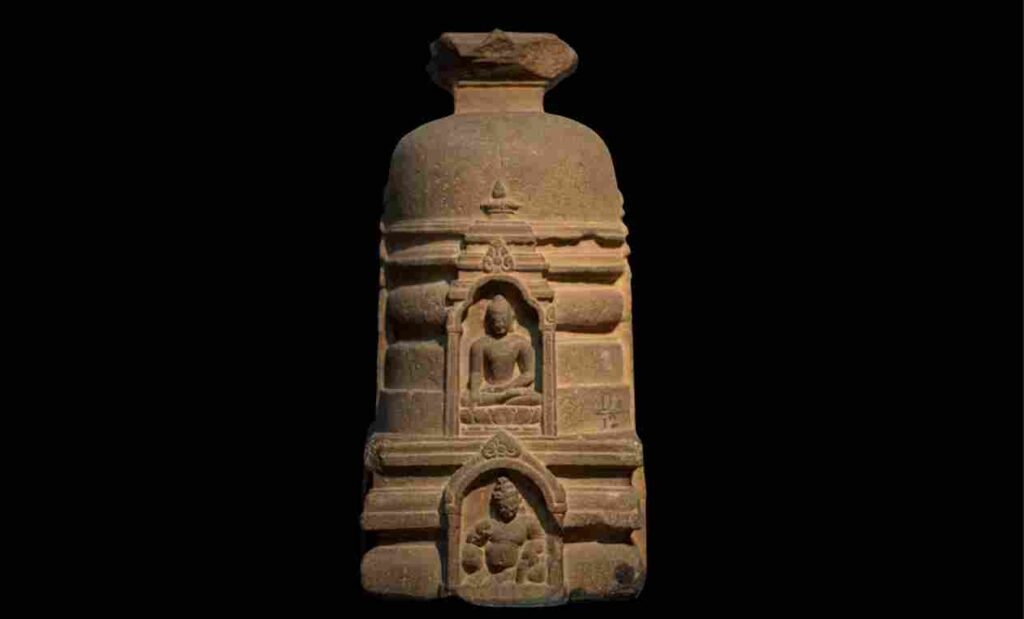
Votive stupa at Sarnath, Gupta period, 300–600 CE