Lingam, Lingodhbhava, Dakshinamurthy
What is the Lingodbhavamurthy? Why does India have only a handful of temples dedicated to Brahma?
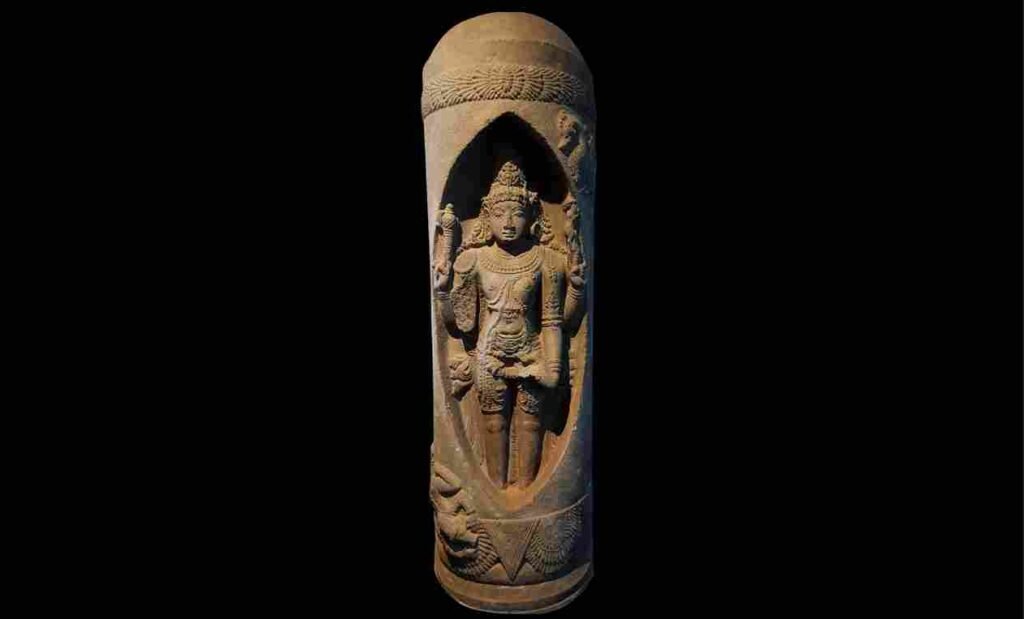
Walk up to the Later Chola Sculptures bay on the ground floor and play this story there.
Can you spot a sculpture named Lingodbhavamurthy in the Later Chola sculptures Bay? Statues like these are called Lingodbhavars. The elegant figure carved inside the cylindrical stone is Shiva, the Hindu god of destruction. Do you also see a small figure of a swan on the top and the figure of a boar at the bottom of the statue? The swan is Brahma, the god of creation and the boar is Vishnu, the preserver of the universe. But why are they represented in this manner?
Legend has it that the story of Lingodbhavamurthy began with a quarrel between Vishnu and Brahma. They argued endlessly and fought tooth and nail over which one of them was supreme. Suddenly, Shiva took the form of a great flaming pillar that pierced through the earth and sky. He challenged the two to find the beginning and end of this form. The first one to accomplish this task would be considered the greater god. Brahma immediately flew up into the sky as a swan to find the end while Vishnu burrowed down into the earth as a boar to find the beginning. On and on they journeyed but neither of them could find the beginning nor the end of Shiva. Vishnu accepted defeat. But Brahma lied, and claimed to have found the end. Shiva, of course, saw through this lie and was furious. He cursed Brahma that no one would worship him on earth. This is the story that you see represented in front of you. And it is one of the stories that explains the very real absence of temples dedicated to Brahma in India. There are only a small handful of Brahma temples, as against the thousands dedicated to Shiva and Vishnu.
Today, the lingodbhavamurti is commonly found in most Shiva temples of Tamil Nadu. This form was made popular during the Chola period.
The cylindrical stone itself is called the lingam and is the most common representation of Shiva. In Sanskrit, the word lingam means a ‘sign’ or ‘symbol’. It is commonly believed that the lingam is a phallic symbol.
Indeed, lingam worship dates way back into the past, to at least 5000 years ago. The lingam represents the masculine force of the world. It is usually placed on top of a yoni, a base that represents feminine energy. Together, they symbolise creation and life itself.
Did you know that phallic worship was common to most ancient cultures, from Egypt to Mesopotamia and Greece 2000 years ago? In the 1500s, when archaeologists discovered the ruins of Pompeii in Italy, they found it to be full of phallic imagery.
But then again, not everyone agrees with the idea of the lingam being a phallic symbol. There are deeper, more abstract theories about what it actually represents. Whatever it really stands for, the lingam is an extremely common icon across India.