
The Tiger of Mysore
The tale of the Tiger of Mysore, Tipu Sultan.
This free audio tour is brought to you thanks to the generous support of Pando. Visit pando.ai to learn more about them.
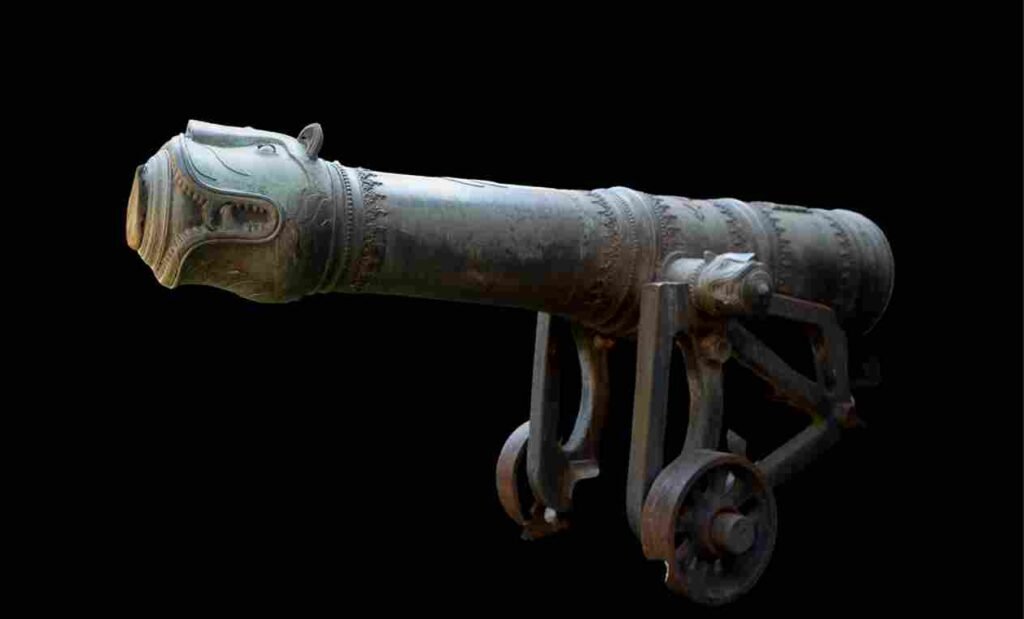
Take a look at this cannon before you. This cannon was used to devastating effect by a king nicknamed the Tiger of Mysore in his final battle in 1799. This is the tale of Tipu Sultan.
By the mid 1700s the British had colonised significant parts of the Indian subcontinent. Yet, one kingdom, the kingdom of Mysore, kept resisting the British. It was led by Hyder Ali, a general who had come to power by placing the royal family of Mysore under house arrest. He was assisted by his son, Tipu Sultan who took over after Hyder’s death. They invaded neighbouring kingdoms, and soon became a dominant power in South India. Naturally, the British weren’t too pleased with this, and so they declared war on the kingdom every chance they got.
But Tipu Sultan was a clever strategist and a bold commander. It is said that he fought like a tiger in every battle that he led, and he was nicknamed ‘The Tiger of Mysore’. He entered into a strategic alliance with the French to counter the British. His ordnance factories in Mysore produced powerful cannon like the one you see here. They were also pioneers in rocket technology. Tipu’s special Rocket Regiment threw the British into disarray in every battle. Not surprisingly, the British usually lost.
Tired of losing every time, the British appointed a veteran general, Lord Cornwallis, to fight the Third Anglo-Mysore War. Cornwallis cleverly allied with the Marathas and managed to defeat Tipu in 1792. Tipu was forced to hand over half his kingdom. He also had to give his two sons as hostages to the British till he paid a war damage claim - a whopping 33 million rupees! The British felt that this was enough to break Tipu.
It was not! Tipu raised the 33 million, rescued his sons and then promptly began raising more money for a new war! This time, the British took no chances. They secretly contacted Tipu’s trusted advisors - to buy them off. They also allied with the Nizam of Hyderabad and brought in his armies. In 1798, the British surrounded Tipu’s fort in Srirangapatna, near Mysore. The Fort was well defended, but then, one of the Mysore commanders unexpectedly withdrew his troops from a Fort wall. The British stormed into the fort. As they moved in, they saw a lone Mysore officer, valiantly firing at them, while his assistants kept reloading his guns. This little group was delaying the British advance. The British musketeers ruthlessly gunned him down and moved forward, searching for Tipu. Finally, they realised that the lone officer at the breach was Tipu himself. Apparently, once the fort was breached, Tipu had decided to take the enemy head on. And he died fighting.
Soon after this war, Mysore became a British vassal state. The Tiger Cannon in front of you was one of the many captured in that battle and brought here as war trophies.

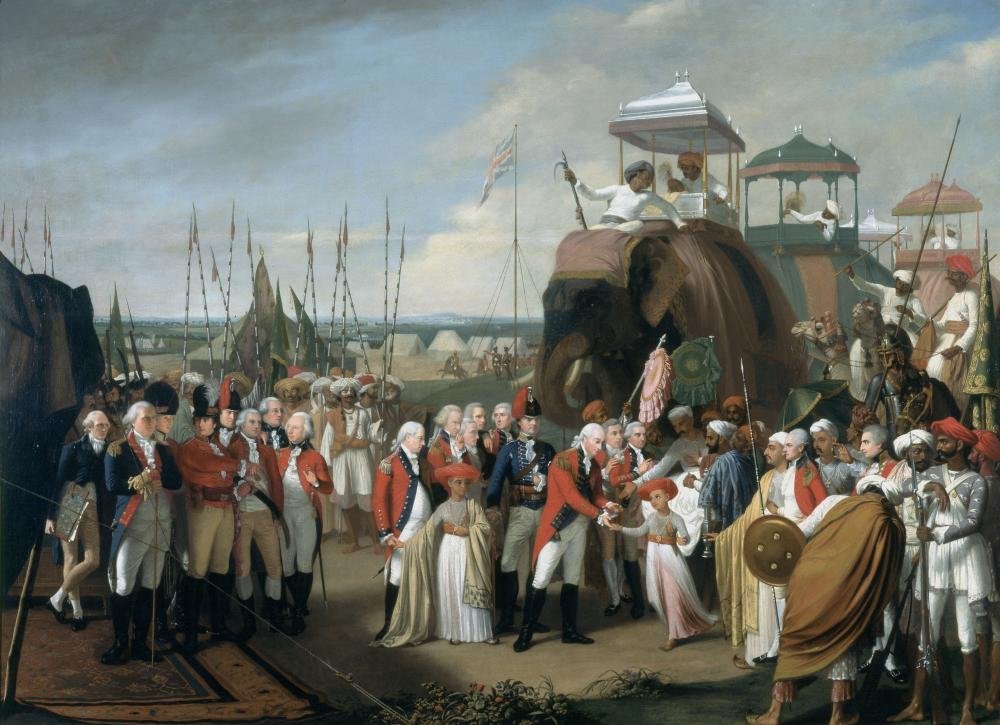
The Reception of the Mysorean Hostage Princes by Marquis Cornwallis, 26 Feb 1792 - A painting by Robert Home
Wikipedia