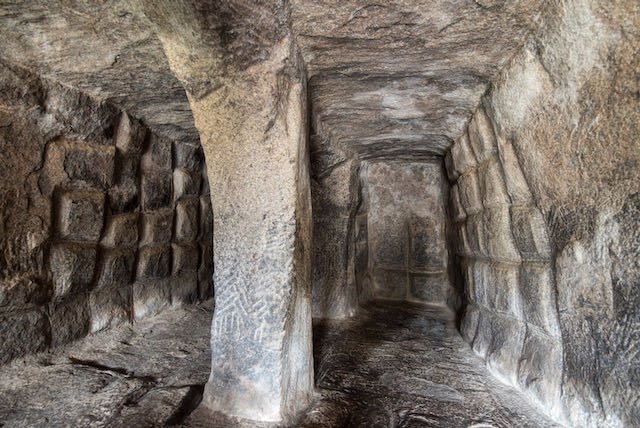
Pancha Pandava Cave
1400 years ago, the sculptors of Mamallapuram managed to carve beautiful temples out of hard granite, with nothing more than primitive tools. How did they do it?
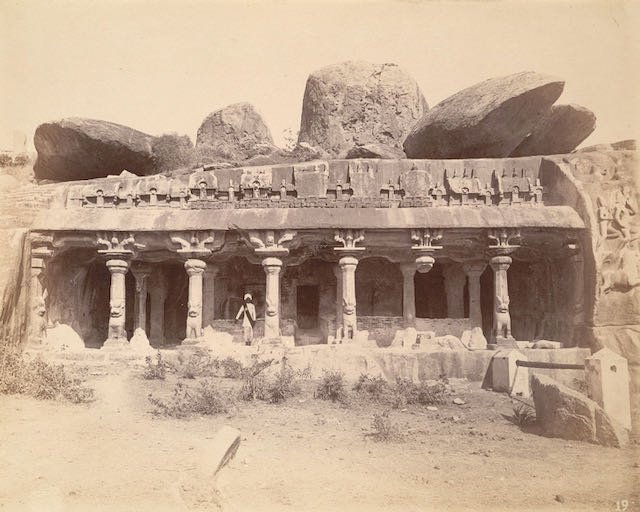
From Krishna Mandapa, continue northwards, and about 50 M away, to your left, you will see the unfinished Pancha Pandava Cave. Play the next story there.
This cave is called the Pancha Pandava cave temple. Just like the Pancha Pandava Rathas, this too has nothing to do with the Pancha Pandavas. It is one of the largest cave temples in Mamallapuram. It remains unfinished and the inner sanctum has no Deity. And there are no inscriptions to guide us. It appears that the artists abandoned this at the early stages.
But there is something unique inside. The sculptors have tried to cut a passage around the main shrine. The chiselled square panels show that this work had already begun, when the cave was abandoned. Had the work been completed, this would have been the only cave temple in Mamallapuram with such a feature.
The Pallava sculptors were comfortable experimenting with stone. But they were not alone in this experimentation. As far back as the 3 century BCE, the Mauryan kings of North India had already carved out rock cut caves in Barabar in modern day Bihar. And around the same time as the Pallavas between 6th and 8th centuries, their contemporaries, the Rashtrakutas were carving elaborate rock cut caves in Ellora, while the Chalukyas were doing the same in Badami. Closer home, the Pandyas had already carved exquisite cave temples just outside Madurai. But the Pallava effort is laudable, given the fact that they had to work on granite which is one of the hardest stones in nature. So how did they cut and shape these heavy stones?
They started by chiselling holes in huge rocks and pushing stout bamboo poles into them. The pole was watered continuously. All that water made the bamboo expand and slowly, but surely, the rock split apart. You can still see the square holes chiselled out by the Pallava masons on abandoned rocks all over Mamallapuram.
But cutting rock was not the only challenge they faced. Monoliths needed precise calculations and sculpting skills. One false move and the whole rock would be wasted. You can still see half-finished monoliths and cave temples scattered around Mamallapuram.
Given the enormous amount of work involved, roles of the workers started getting more and more specialised. A community of hefty men called the Kal-uli-mangans had the job of striking iron wedges into hard rock, over and over again. Kollans were blacksmiths who created the specialised tools needed for this work. Perum Tachans were expert sculptors who handled the finer carvings, and the whole thing was masterminded by the Silpacharya or the chief sculptor. 1300 years ago, Mamallapuram was one big, bustling workshop that attracted the best of artisans. Today, Tamil Nadu is known as the land of temples. And most of them are taller, grander and more imposing than the structures you see here. But this hot, rocky stretch of land is where it all began.

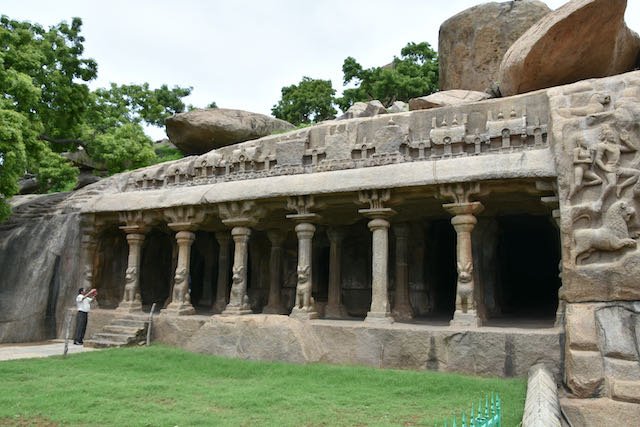
Pancha Pandava Cave
Wikipedia. By Richard Mortel