
Mahishasura Mardhini
This is the story of Durga - goddess of war and slayer of evil demons. Why is she called Mahishasura Mardhini?
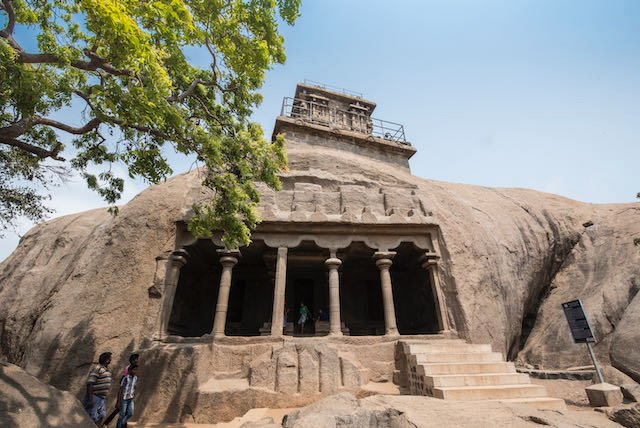
From the Raya Gopuram, follow the winding path that takes you southwards towards the lighthouse that is about 300m away. Cross the lighthouse and a little further ahead on your right you will see a monument called the Mahishasura Mardhini Cave. Play the next story here.
This location is linked to multiple stories. You can see the list of stories on your screen. You can play them all in the same order or click on any story you wish to play.
This rock cut cave temple is called the Mahishasura Mardhini cave. Inside, to your right, you can see a panel that is considered one of the best works of the Pallava period - the Mahishasura Mardhini panel. It depicts Goddess Durga slaying a demon called Mahishasura.
Story goes that there once lived a powerful demon king named Mahishasura. Like most demon kings, he too was hungry for power and he too wanted to live forever. So he prayed to Lord Brahma, the god of Creation. Pleased with his prayers and lengthy penance, Brahma appeared before him and asked him to make a wish. Mahishasura asked that he should not be killed - not by man, nor God, nor beast nor demon. And Brahma, perhaps not thinking this fully through, granted him this boon.
Mahishasura went back to the netherworld, a smug and arrogant demon. Very soon he attacked the earth and the heavens, and conquered them both. Indra, the defeated King of heaven, appealed to the gods for help. But there was little the Gods could do. The terms of the boon were very clear - this demon could not be defeated by the Gods, by men, by beasts or by other demons. And that’s when they found an answer staring them in the face. The terms made no mention of a woman! So they put their energies together and created an amazingly powerful goddess. She was named Durga. They gave her their best weapons and sent her to destroy this evil demon.
That’s how they say, Durga came to earth, riding a lion, all primed for battle. Durga fought Mahishasura fiercely for nine days and nine nights. Finally, on the tenth day, she pinned Mahishasura under her foot and cut off his head. She came to be known as Mahishasura Mardhini or the “one who vanquished Mahishasura.” In the panel, you can see Durga charging forward on a fierce-looking lion, carrying an assortment of weapons. She is accompanied by her army of female warriors, helped by a troop of ganas or dwarfs. This scene is clearly the last leg of the battle. Mahishasura, the buffalo headed demon, is on the retreat and is portrayed as shrinking back in fear. The sculptor has seamlessly blended the buffalo head on a human body. One of the ganas on the top left has already sensed victory and is seen distributing sweets!
This victory of good over evil is celebrated all over India in some form or the other. In many parts of India, the festival is called Navaratri - literally meaning nine nights. It is believed that this is when the Gods come down to earth and take up ringside seats to witness the mother of all battles - the battle between Durga and Mahishasura. Many households in south India celebrate the festival by setting up a display of colourful idols of Gods on a rack with multiple steps, symbolically giving them a seat to watch the battle. In the eastern part of the country, Durga Puja is the biggest festival in Bengal. While Hinduism celebrates many male gods, the cult of Shakti - the female goddess - is an equally important and vibrant part of this religion.

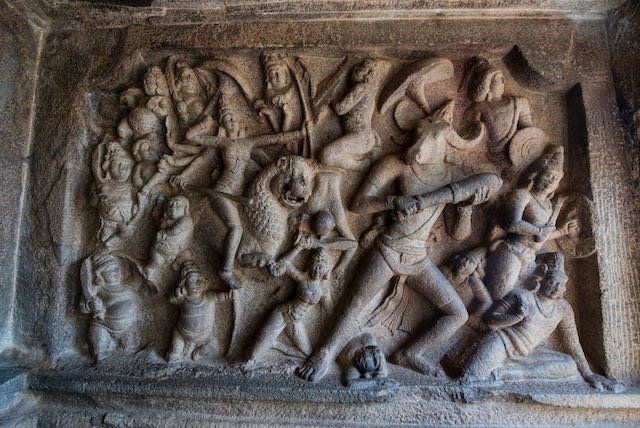
Mahishasura Mardhini panel depicting Goddess Durga slaying a demon called Mahishasura
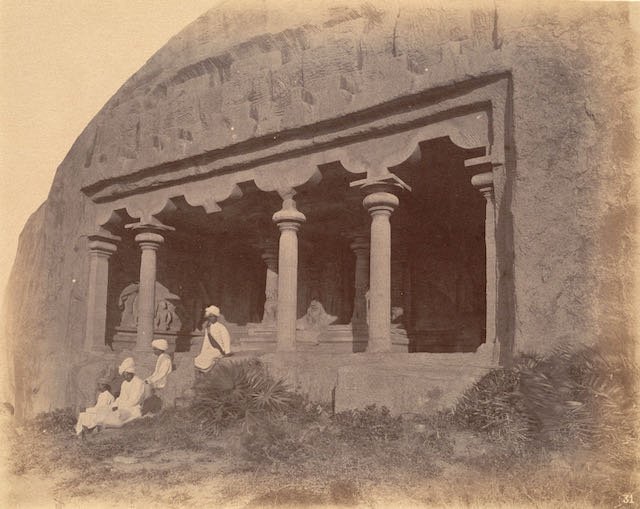
Mahishasura Mardhini Cave, 1885
British Library. By Alexander Rea, 1885