Gajalakshmi and Kottravai
Meet two powerful goddesses: Gajalakshmi, a motif symbolising abundance and prosperity, and the warrior goddess Kottravai, who was worshipped by Tamil soldiers centuries ago.
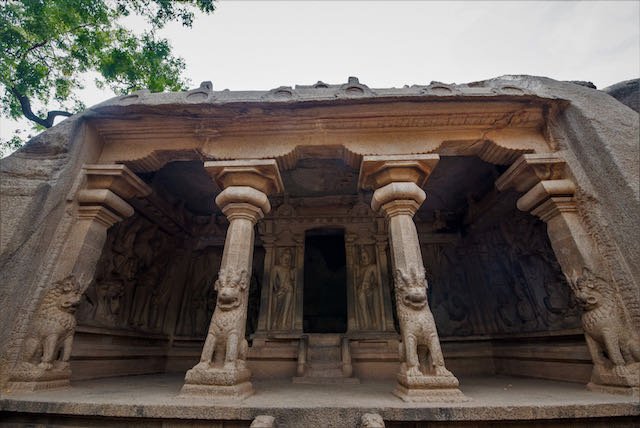
From the Ganesha Ratha, continue walking in the same direction up the hill for another 50m. You will see a structure called the Varaha Mandapa on your left. Play the next story there.
This location is linked to multiple stories. You can see the list of stories on your screen. You can play them all in the same order or click on any story you wish to play.
This structure is called the Varaha Mandapa or the Varaha cave temple. This is one of the best examples of a cave temple in Mamallapuram.
Cave temples involved gouging out the insides of a large granite rock. The first cave temples in the Pallava empire were constructed in the early 7th century, during the reign of Mahendravarman 1. One of his earliest works was the Mandagapattu Cave Temple about 115 Kms from here. His inscription at Mandagapattu proudly declares that he was ‘Vichitra-chitta’ or the ‘innovative thinker’ pioneering a new architectural style that did not use wood, brick, metal or mortar.
You may have noticed that while these rock cut cave temples have a sanctum, they do not have idols inside. In the early stages of cave temple architecture the sanctum never had a stone idol. That was because in that era, stones were associated with death and typically used for tombstones and hero stones, but not idols of Gods. The image for worship was usually a panel on the cave wall - like the Somaskanda, or sometimes wooden or stucco images. You can see lingams in some cave temples, but these were later additions that came when Lingam worship gradually became popular in these parts.
This cave temple was built in the early 8th century. Inside, you will see four beautifully carved panels that tell four different stories from Hindu Mythology. Let’s first talk about the two panels facing the entrance, on either side of the shrine.
The panel facing you on the left is called the Gaja Lakshmi panel. Lord Vishnu is the all-powerful god of protection in the Hindu line-up of Gods. But his wife Goddess Lakshmi has a following that far exceeds Vishnu’s. And why ever not. She is the goddess of wealth, afterall.
But then, wealth means different things to different communities. The trading community in North India worships her as the goddess of riches – Aishwarya Lakshmi, Aishwarya meaning riches. To the warrior clan, she is the goddess of war – Veera Lakshmi – where veera means courage. The farmers worship her as Dhanya Lakshmi – the goddess of grains. And the educated class worships her as Vidya Lakshmi – the goddess of knowledge. It doesn’t end there. A popular prayer to Lakshmi is the Lakshmi Sahasra namam, literally meaning the 1000 names of Lakshmi. It goes on to list them all out.
What you see before you is a depiction of Gaja lakshmi - meaning Lakshmi with the elephants. In this motif Lakshmi is flanked by two elephants that are showering water over her head. In India, elephants have traditionally been associated with royalty. And so this icon has come to symbolise abundance. The icon of Gajalakshmi dates at least as far back as the 2nd century BCE. Even today, many Hindu households carve an image of Gajalakshmi above their front doors as a sign of prosperity.
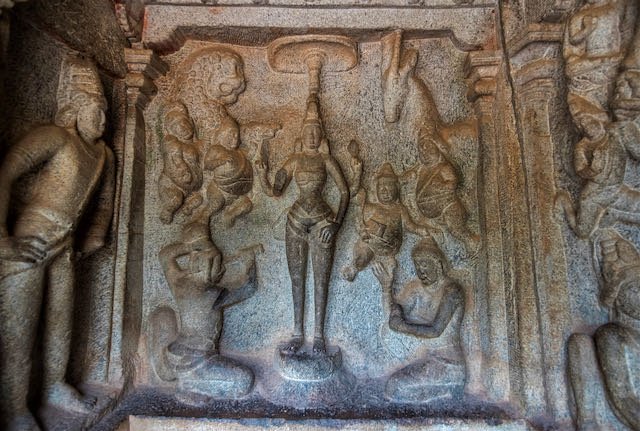
The panel facing you on the right side of the shrine depicts Durga, also known as Kotravai in these parts. Kotravai was the warrior goddess worshipped by ancient Tamil soldiers. In time, it is believed that Kotravai got absorbed into the larger Hindu pantheon as goddess Durga. It is difficult to miss the image of the man kneeling at Durga’s feet, in the act of cutting off his own head. Back then, it was not uncommon for an individual to voluntarily sacrifice his limb or even his life for a greater cause. It was believed that it brought good luck and was a common practice during times of war.

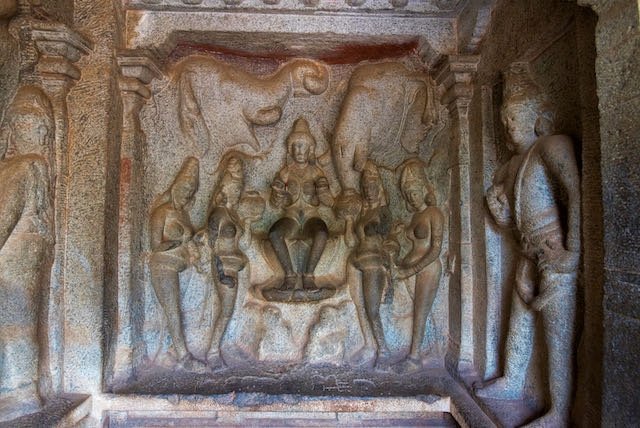
Sculpture of Goddess Gajalakshmi being showered with water by elephants