Sthalasayana Perumal Temple
This is the story of the Sthalasayana Perumal Temple, one of the 108 'Divya Desams' or Vishnu temples that are considered to be particularly sacred.
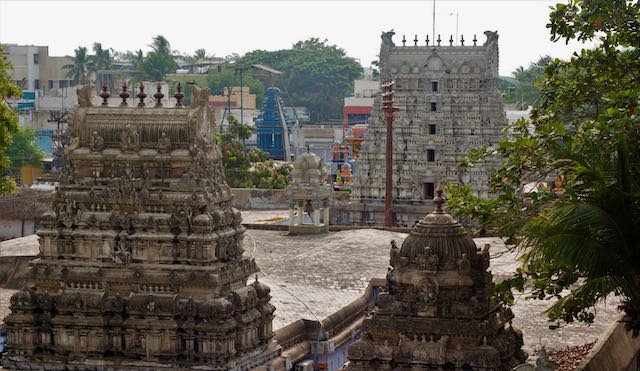
From the Shore Temple, take the Beach Road, turn right on to East Raja street and left onto North Mada street. You can park your vehicle at the parking lot on your right at the end of this street. Walk across the road to the Sthalasayana Perumal Temple.
This location is linked to multiple stories. You can see the list of stories on your screen. You can play them all in the same order or click on any story you wish to play
This ancient temple in the heart of Mamallapuram is called the Sthalasayana Perumal temple. How old is it? We can’t say definitively. But we do know that it was in existence when the Pallavas were at their peak.
The Sthala Sayana Perumal temple has a statue of Lord Vishnu, the god of protection, in a reclining position. In Sanskrit, “Sthala” means a place, “Sayana” means to lie down, and “Perumal” is the Tamil name for Lord Vishnu. In temples where Vishnu is portrayed in a reclining position, he is usually shown lying on a divine serpent called Adi Sesha. In this particular temple Vishnu is lying on hard ground. So Sthala Sayana Perumal means Lord Vishnu who is reclining on the ground. Why is he lying down? We’ll discuss that in the next story.
This temple is one of the 108 Vishnu temples spread across the sub-continent that are believed to be particularly sacred. All of them are considered important symbols of Hindu revivalism. But why revive Hinduism, when it was already the dominant religion in the subcontinent? That’s because about 2000 years ago, it faced tough competition from two younger religions that emerged from the subcontinent - Jainism and Buddhism. These new religions seemed way simpler to the common folk, and started weaning followers away.
But around the 6th century CE, a Hindu resurgence movement, called the Bhakti Movement began in South India. Bhakti means ‘devotion’ and this movement attempted to simplify Hinduism for the masses and downplayed caste and social distinction. The movement was led by two groups of saints from Tamil Nadu. One class of 63 saints called the Nayanmars wrote beautiful hymns praising Lord Siva. Another class of 12 saints called the Alwars sang devotional songs about Lord Vishnu. Slowly, but surely, people swung back to Hinduism. Not long after, the Bhakti movement spread from Tamil Nadu to other parts of India too.
The Pallava period was witness to all these religious shifts. Kings switched between religions, and kingdoms followed. By the time the Pallavas reached their peak, all the three religions co-existed in these lands. King Mahendra Varman wrote a satirical play which has many references to this. He himself started life as a Jain, but later converted to Shaivism. Later. a Chinese traveller named Hiuen Tsang who visited Kanchipuram in the 7th century, wrote that the Pallava capital, had as many Buddhists and Jain shrines as it had Hindu temples.
The Pallavas were primarily Shiva worshippers, but were tolerant of other faiths. The Sthalasayana Perumal temple is a Vishnu temple that existed during the rule of the Pallavas, and was built upon by later dynasties including the Cholas and Vijayanagara kings. This temple is the 63rd in the list of 108 Divya Desams or sacred Vishnu temples that feature in the songs of the Alwar saints.

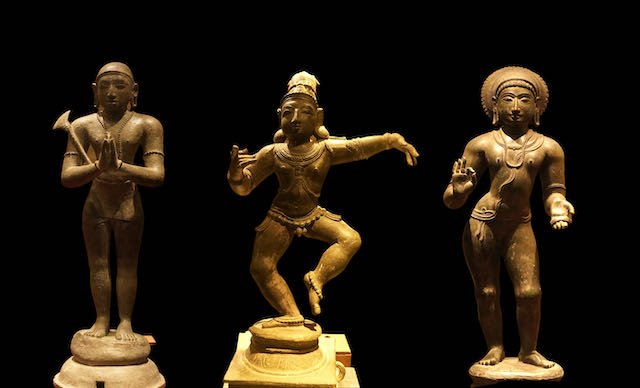
Bronze sculptures of Shaivite saints from Egmore Museum, Chennai: Appar (left), Tirugnanasambandar (middle), Manickavasagar (right)