Dharmaraja Ratha
This story takes you to the biggest and the most intricately sculpted monument among the Five Rathas - the Dharmaraja Ratha.
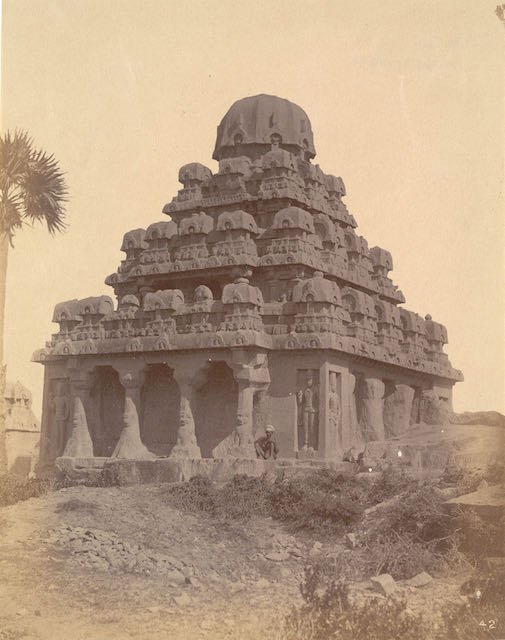
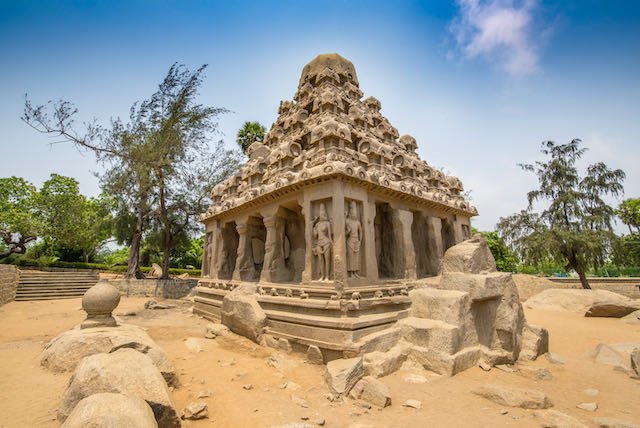
At the far corner of this complex is the most striking of the 5 Rathas, called the Dharmaraja Ratha. Dharmaraja or Yudhishtira was the oldest of the Pandava brothers, and the most righteous of them all. This structure is the biggest and the most intricately sculpted among the Five Rathas, but it remains unfinished. Had it been completed, this would have been one of the few 3 tiered structures of this size in the world to be carved out of a single rock.
The Dharmaraja ratha is a treasure-house of intricate sculptures, mostly of Siva. The walls of the ground floor have 8 niches with almost life-like icons. On the north wall at north-eastern corner is a relief sculpture of Shiva in the form of Ardhanareeswara or “the Lord whose one half is woman.”
Here, Shiva is represented as half man and half woman. The female half is his wife, Goddess Parvati. The interpretation of this unusual form is that the cosmos is essentially the synthesis of male and female energies. Look closely and you will see that one half of the statue is completely masculine with one hand wielding a battle axe. The other side is distinctly feminine, with a soft chin, rounded shoulder, curvaceous hips, bangles on the wrist, the headgear, a flower in the hand and slender but covered legs. The beauty of the sculpture is that the male and female form seamlessly blend at the centre. This sculpture is a classic example of how Pallava sculptors were able to capture subtle expressions on hard granite.
A similar idea is depicted in another composite figure from Hinduism, that you can see on the other end of the north-western corner. That is Hari Hara who is half-Shiva and half-Vishnu. One can identify the two gods by the objects they hold in the upper hand. The statue symbolises that Siva and Vishnu, though worshipped as different gods, are both manifestations of one supreme almighty. Here too the Pallava sculptors have beautifully blended two different personas, while strictly adhering to the rules of iconography!
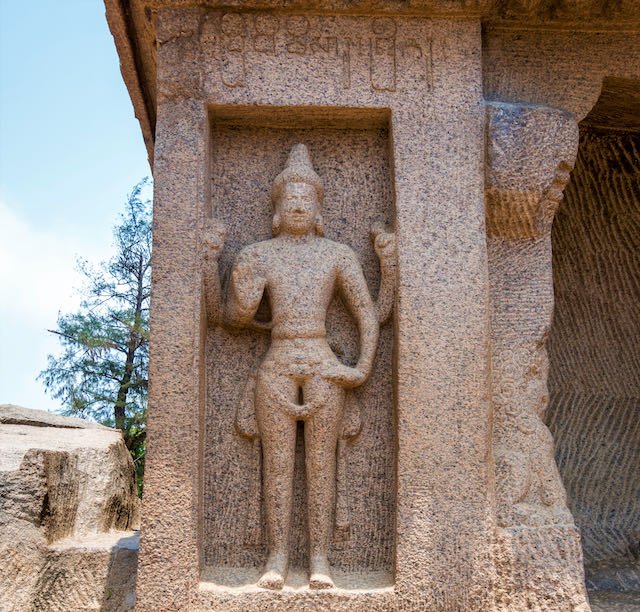
The south-facing wall of the south-western corner has a statue that appears to be of a royal figure. This is believed to be a portrait of King Mamalla himself, who gave the name to this historic town. Inscriptions of his many titles in the Pallava grantha script can be seen above carvings on this structure.
The second and third floors are also filled with carvings of Shiva and other deities. The third floor has a lovely Somaskanda carving – a family portrait of Lord Siva with wife goddess Parvati and son Muruga. The monument was never completed and for safety reasons, the second and third levels are not open to the public.

Dharmaraja Ratha
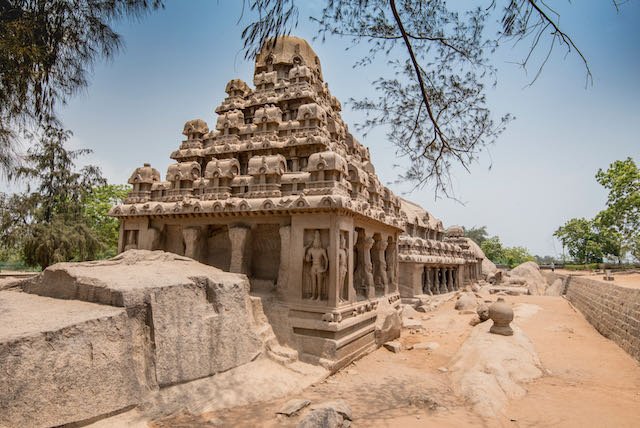
Dharmaraja Ratha, viewed from the south-eastern corner
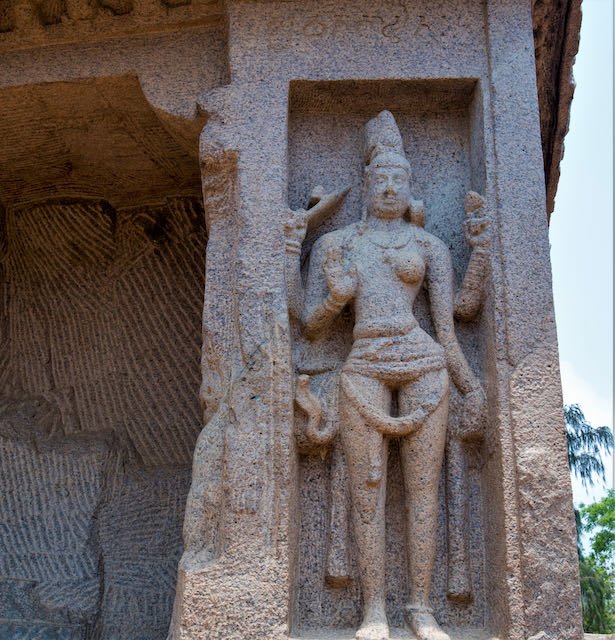
Dharmaraja Ratha, north wall depicting Ardhanarishvara, a form of Shiva