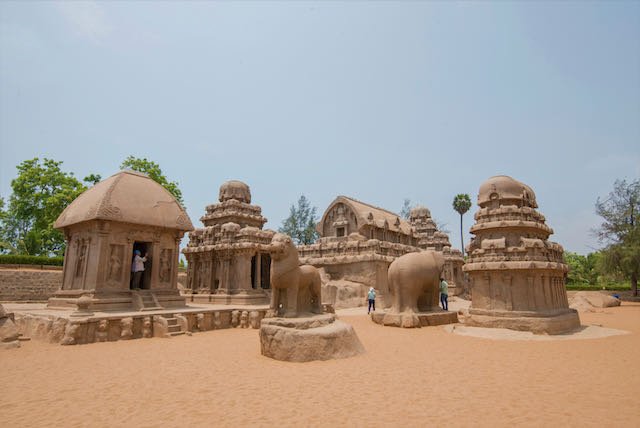
Bhima and Nakula Sahadeva Rathas
The Bhima Ratha is a testament to the co-existence of religions during Pallava times. Did you notice that the Nakula Sahadeva Ratha has an interesting shape?
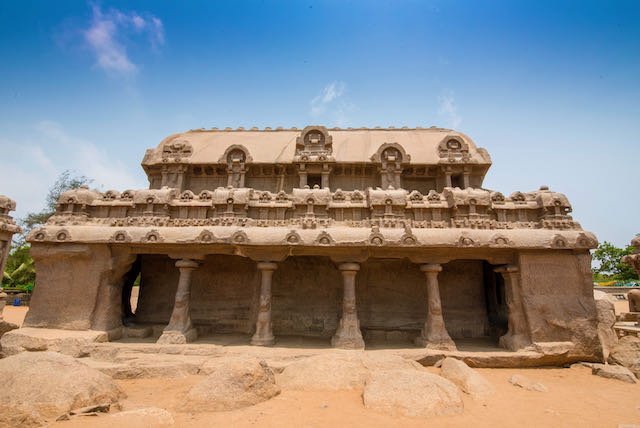
The oblong shaped structure next to Arjuna Ratha is called the Bhima Ratha. In the Mahabharata, Bhima was the strongest of the Pandavas. This ratha was built to house a statue of Anantashayana Vishnu or Lord Vishnu in a reclining posture. Along the outer edges of the roof, you can spot carved faces peering out of circular windows. This is called a koodu or a Chaitya window and was commonly seen in Buddhist architecture too. Other religious influences in architecture were fairly common during the Pallava period. At the height of Pallava reign, three religions - namely Buddhism, Jainism and Hinduism - were known to coexist, and it wasn’t uncommon for the kings themselves to switch between religions.
Can you see a statue of an elephant opposite the Arjuna and Bhima Rathas? The ratha next to it is the Nakula-Sahadeva Ratha. In the Mahabharata, Nakula and Sahadeva are twins and the youngest of the five brothers. This ratha is different from the rest. It has a curving back wall. So what is so special about that? Take a look at the back of the elephant standing right beside it. Can you see the similarity in shape? The sculptor, very cleverly, modelled the ratha on the lines of the elephant’s backside! Structures having this shape were called gaja-prishta in Indian architecture. This ratha is connected to a different rock at the base – unlike the other four rathas which are from a single mother-rock.

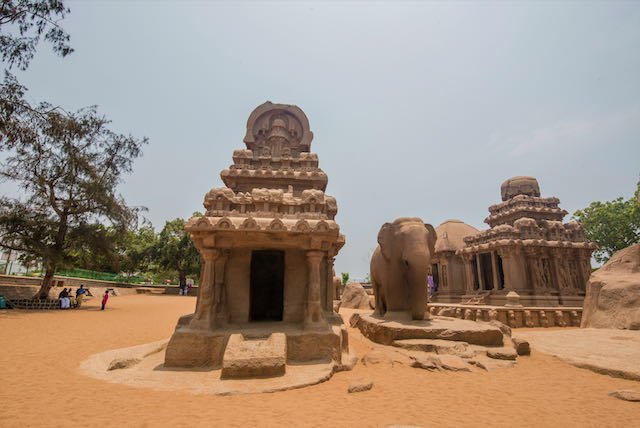
Nakula Sahadeva Ratha with elephant
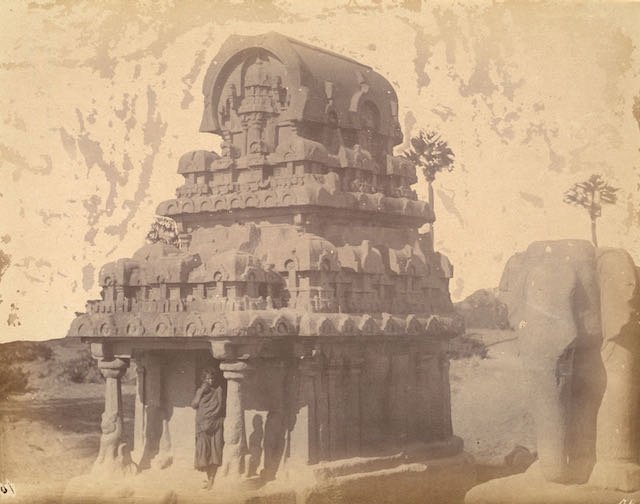
Nakula Sahadeva Ratha with elephant, 1885
British Library. By Alexander Rea, 1885