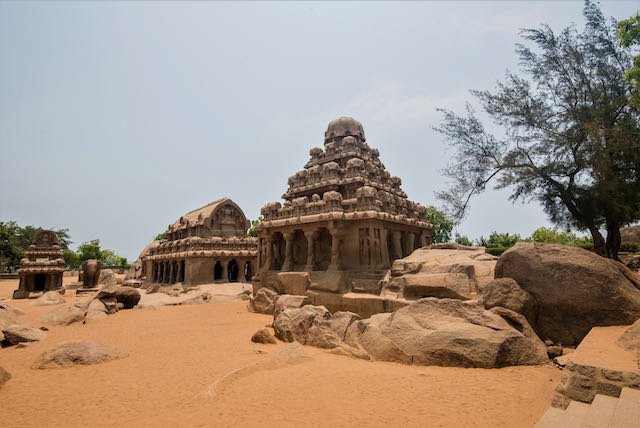
Pancha Rathas
Why are so many monuments in Mamallapuram named after the Pandavas, the heroes of the Mahabharata? What makes the Pancha Pandava Rathas an architectural marvel?
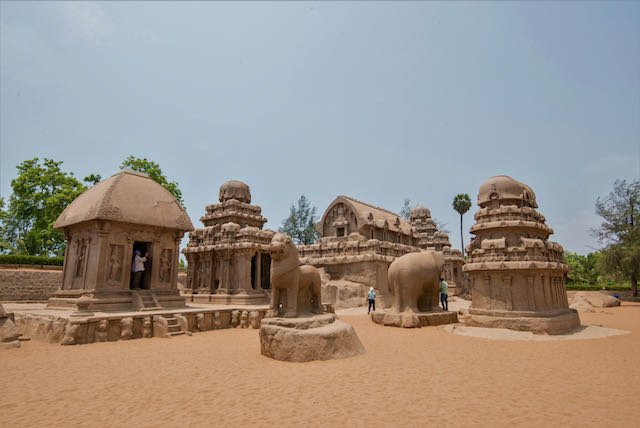
Enter the Five Rathas Monument and play this story.
These monuments you see before you are called the Pancha Pandava Rathas.
These structures may look simple but they are very fine examples of craftsmanship. These structures are monoliths, meaning that they are made out of a single rock. The sculptors chose a large rock, imagined a design in their heads, and started cutting into the rock from the top, all the way down to the bottom to create a temple-like structure. And when they reached ground level, they just chiselled a doorway, went in, and continued gouging out rock until they had a small room. The creation of such rock-cut temples required precise calculations and sculpting skills. One false move and the whole rock would be wasted. This style was in vogue in the mid 7th century - a time when the Pallavas hadn’t yet mastered the technique of building structural temples. So they simply carved large rocks into free standing structures. The Pancha Pandava Rathas are the best examples of rock-cut temples in Mamallapuram.
The name Pancha Pandava Rathas means “the chariots of the five Pandavas.” The five Pandava brothers were heroes of an ancient Indian epic called the Mahabharata.
So how are these structures connected with the Pandavas? They are not. Someone at some point decided to associate them with the Pancha Pandavas, simply because there were five of them, just like the 5 brothers. Some people wrongly assumed that the structures looked like ancient chariots. So they called them Rathas, meaning chariots. And so the name Pancha Pandava rathas stuck.
But why were these structures carved? We don’t know, because they were left incomplete. Perhaps they were made because the Pallavas in the 7th century were experimenting with stone and these were readily available designs to copy. Each of the five rathas is different from the others. Some scholars believe that they were stone models of existing temples of the time which were typically made of wood and brick. It is believed that these were never used as places of worship because they were never consecrated. For a temple to be consecrated, it has to have a finial - a lotus bud shaped structure installed right at the very top. But in these monuments, you will find the finials placed on the floor.
But what’s most interesting about the Pancha Pandava rathas is that they are NOT five different monoliths. Four of them that you see in a row - the Draupadi, Arjuna Bhima and Dharmaraja rathas - are part of one large single rock which is connected below the surface, making it one huge monolith. Isn’t that incredible?

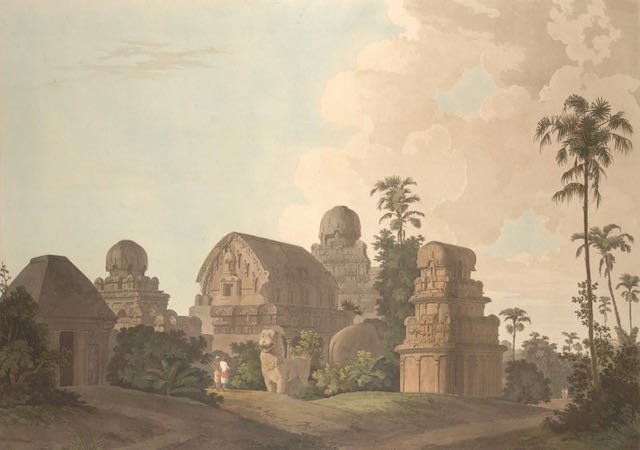
Aquatint showing Pancha Pandava Rathas (Five Rathas), 1799
British Library. By Thomas Daniell, 1799
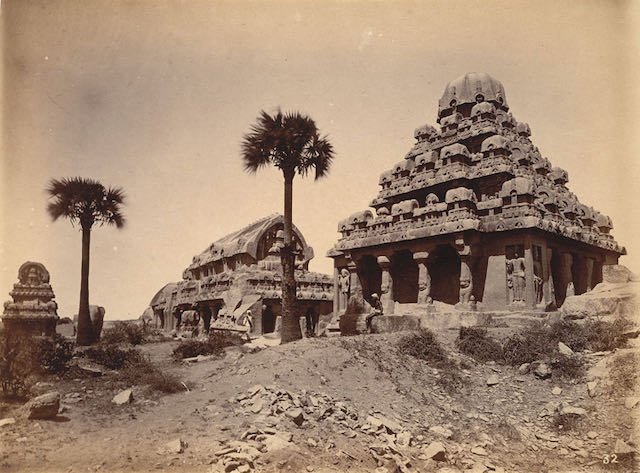
Pancha Pandava Rathas (Five Rathas), 1885
British Library. By Alexander Rea, 1885