Chakra - a weapon and a symbol
The story of the Chakra - Vishnu's weapon and a Vaishnavite symbol in its own right.
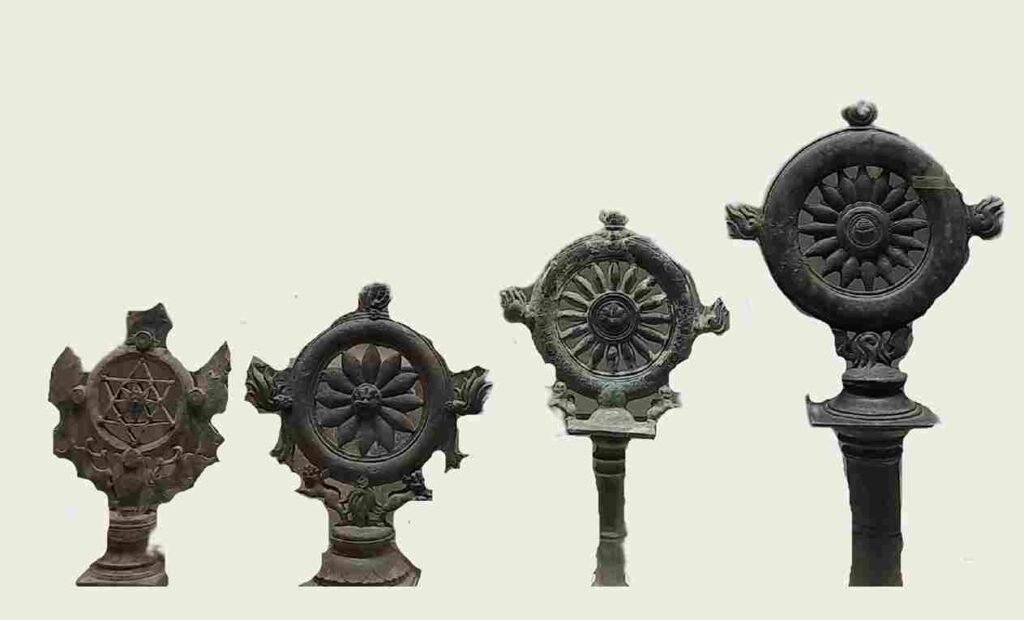
Walk up to the second-last showcase on this aisle and look for sculptures marked ‘Chakra’. Play this story there.
The exhibits you see here are representations of the Sudarsana Chakra - Lord Vishnu’s weapon and a Vaishnavite symbol in its own right.
According to a Shaivite legend, a long long time ago, Lord Vishnu was looking for a weapon to destroy his enemies. To obtain a powerful one, he prayed to Lord Shiva. Pleased with his devotion, Shiva gave him the Sudarsana Chakra - a flying disk with 108 sharp edges. You can see images representing this story in many Shiva temples - including the Pallava-era Kailasanatha Temple in Kanchi.
It is said that the Sudarsana Chakra never misses its target and always comes back to Vishnu after it hits its mark — not unlike a boomerang. Vishnu has used it several times over several lifetimes. As Krishna, he used it to behead his jealous cousin, Shishupala.
Over time, the Chakra became one of the defining symbols of Vaishnavism. Most sculptures you see in this gallery will bear 3 symbols — the Chakra or the flying disk, the Shanka or the conch-shell and the Namam or U-shaped tilak mark. These symbols are considered to be of great significance in the Vaishnavite tradition. During the Bhakti movement, they were used to differentiate believers of Vishnu from believers of Shiva. They continue to be used for identification purposes even today. They are worn as marks on bodies of devotees during temple rituals and marriages. Orthodox devotees brand these symbols on their upper arms even today. They are also kept as religious symbols in prayer rooms and are included in the designs of ritual objects such as lamps.
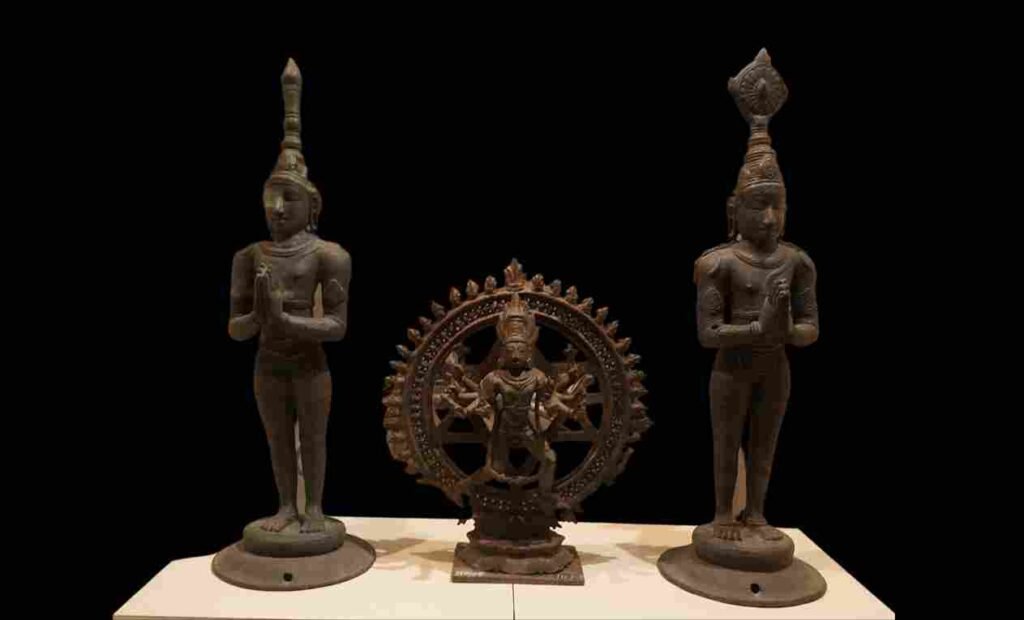
It is particularly interesting to note that the Chakra is represented in an anthropomorphic form as well – known as Sudarsana, Chakraperumal or Chakkrathalwar. So he is Vishnu’s weapon, but has become a god too. Most Vishnu temples have a separate shrine for Chakrathazhwar. You can see a sculpture of Sudarsana in an adjoining showcase in this gallery. You can also see a representation of Kaumodaki, which is the gada or mace that Vishnu carries.
This free audio tour is brought to you thanks to the generous support of Pando. Visit pando.ai to learn more about them.