
Tripurantaka
The story of Shiva as Tripurantaka - one of the most popular representations of Shiva during the Chola period.
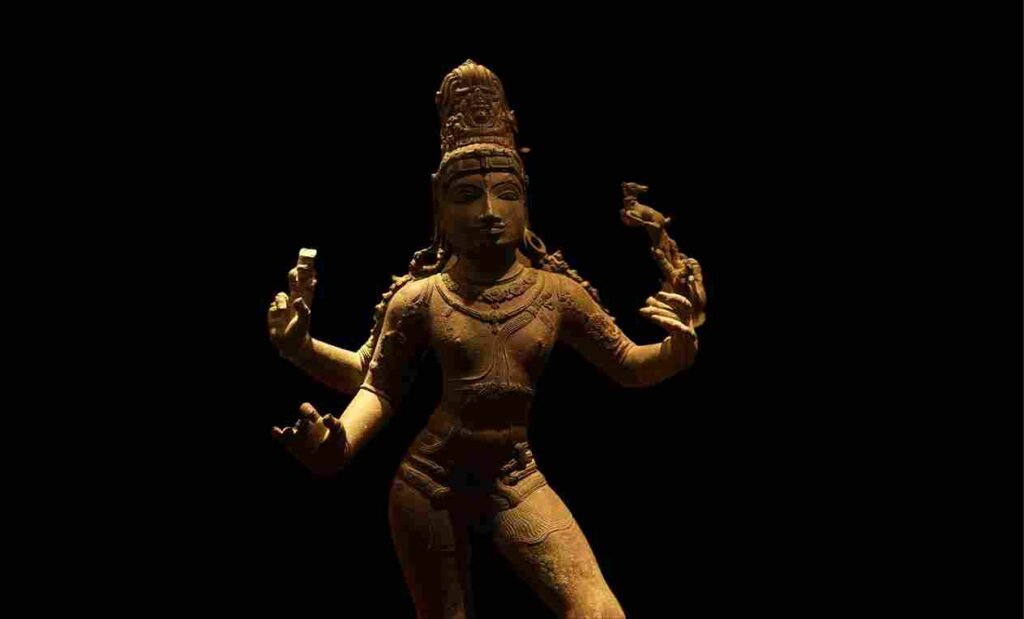
Walk up to the next showcase and look for a sculpture marked ‘Tripurantaka’, the subject of this story.
This sculpture depicts Shiva in the form of Tripurantaka. The name literally means the ‘destroyer of three cities’. In the first 100 years of the rule of the Imperial Cholas, sculptures of Shiva in the form of Tripurantaka outnumbered every other depiction of him. The majestic Brihadeeswara temple in Thanjavur, built in 1010 CE and considered the epitome of Chola art and architecture even today, features 32 sculptures of Tripurantaka, housed on every side of the upper levels.
Who was Tripurantaka?
Story goes that there once lived three demon brothers — Taarakaaksha, Kamalaaksha and Vidyunmali, who like every other demon wanted to live forever. But they also knew that no god would ever grant them the boon of immortality. So after years of rigorous penance, when they managed to get a boon from Lord Brahma, they chose their words very carefully. They asked for a gift of three invincible forts — one travelling the earth, the other floating in the skies and the third soaring through the heavens. Their condition was that the forts could be destroyed only if one single arrow went through ALL three forts in one go. This was the only way the demons could be killed.
Each brother took a fort for himself and ruled from there, believing that they were immortal. And that power made them arrogant. They started bullying humans, harassing the gods, and created a lot of havoc.
The gods went to Shiva for protection and he agreed to help. But not wanting to leave anything to chance, they decided to equip him with the mightiest weapon ever built. In another version of the story, the gods came together to become his weapon. All Shiva had to do was launch the weapon at the precise moment when the three orbiting forts aligned.
Now, the Gods believed that they had done all the hard work and Shiva had to merely finish the job. Shiva, sensing this arrogance of gods, chose to NOT use their magical weapon. Instead, he let loose his own magical arrow and blew up all the three forts in one go. In one version of the story, he merely smiled, and that was enough to burn the three forts down.
It is also believed that after burning the three forts down, Shiva smeared three strokes of ash on his forehead. To this day, followers of Shiva smear their foreheads with holy ash, symbolising this very act of Tripurantaka.
You can recognise Tripurantaka by his hand postures and the objects in them. He is meant to be standing holding a bowstring. He holds a chisel and a pet antelope in two other hands and holds another hand in the kartari-hasta pose, also known as the arrows shaft face. On his left typically is a figure of Devi or the Goddess. He has three eyes, and on wall murals, he is usually depicted using red pigment.

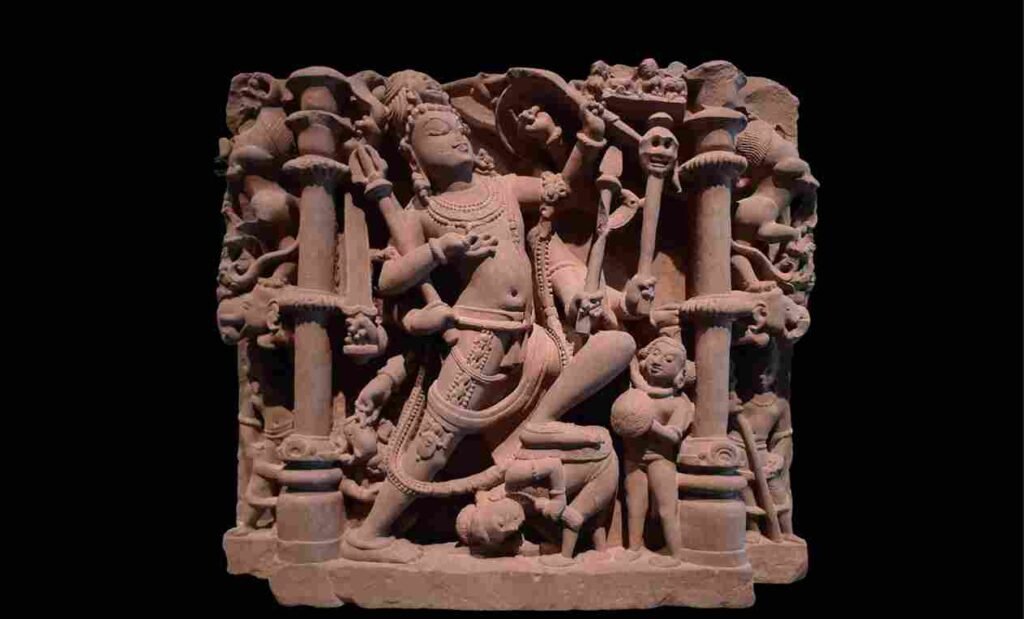
Sculpture of Tripurantaka, Asian Art Museum, San Francisco, 11th century CE
Wikipedia. Photo by Marshall Astor