
Ardhanarishvara
What is the symbolism behind the half-male, half-female form of Shiva?
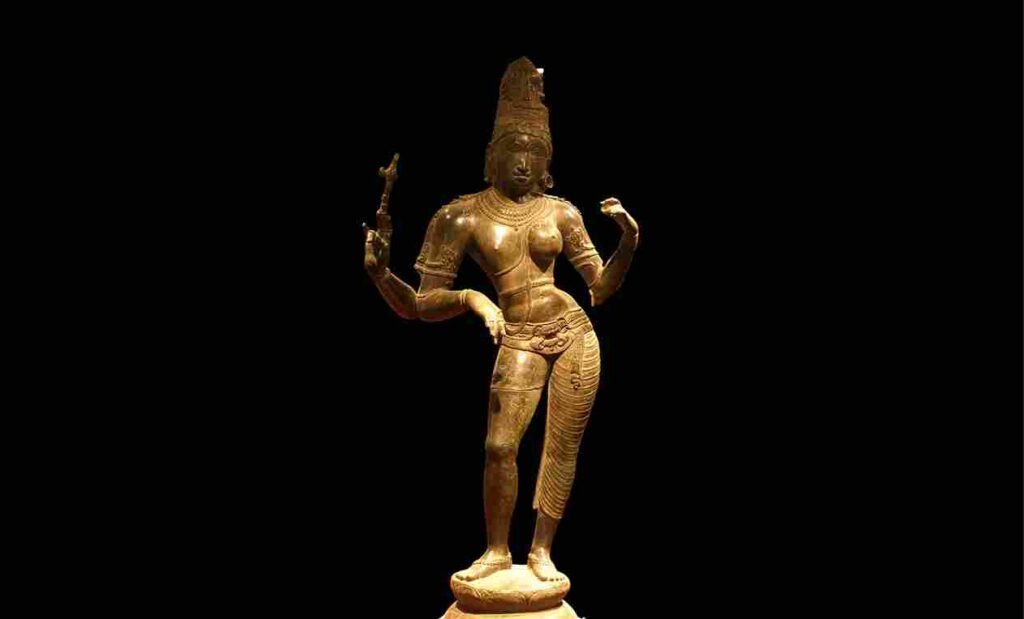
Enter the Shaivite Bronze Gallery and walk towards the showcase in the central bay of this gallery. Look for a sculpture marked Ardhanarishvara. Play this story there.
This gallery is dedicated to Shiva - the Hindu god of destruction. In the first millennium CE, worship of Shiva attained immense popularity throughout the country, so much so that it became a mini-sect in itself. Referred to as Shaivism, it involved the worship of Shiva in his many forms - as Dakshinamurti, the divine teacher, Nataraja, the cosmic dancer, as Bhairava and Tripurantaka, his fiercer manifestations and some other forms that are showcased in this gallery.
What you see here is a representation of Shiva as Ardhanarishvara — literally meaning ‘the lord whose one half is a woman’. Look closely and you will see that one half of the statue is completely masculine while the other half is feminine with a full breast, curved hips and ornaments.
The male half represents Shiva, the almighty god of destruction. The female half represents Parvati, the Great Goddess and Shiva’s wife. How did this unusual form come to be?
One of the stories around this depiction is found in an ancient Hindu text called Linga Purana. At the beginning of time, Brahma wished to create mortals who would multiply themselves. He managed to create men but not women. For this, he asked Lord Shiva for help. Shiva then presented himself as Ardhanarishvara, the lord whose one half is a woman. However, the male and female sides in this form hold no procreative association. They are one undivided whole. At Brahma’s request, they split themselves into separate male and female entities. And creation happened thereafter.
Statues of Ardhanarishvara were commonly sculpted during the Pallava and Chola periods between the 1st and 11th century CE. There is evidence that Shiva was worshipped in this form at that time, but the practice seems to have disappeared in later years. Although you can see variations in the depictions of Ardhanarishvara, all of them do follow a common set of rules. For instance, the image is always divided perfectly along a central axis. The right side is always male and the left half, female. The male half has a flat chest, half-moustache, broad right shoulder with 2 arms, a thicker thigh and a wider waist. You can also see Shiva’s dreadlocks ornamented with snakes, a crescent moon, and the goddess Ganga. The female side on the other hand displays a braided hairstyle or a bun laden with jewels, a smaller waist, a fuller hip and a breast.
There are many interpretations for this form of Shiva. Many believe it represents the cosmos with its masculine and feminine energies – the yin and the yang. It makes a clear statement that even a god like the almighty Shiva gets half his power from his wife, Parvati.

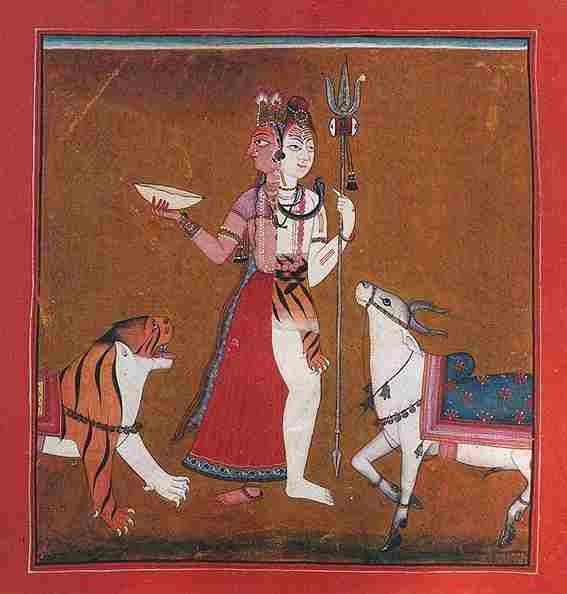
Painting of Siva as the lord who is half-woman (Ardhanarishvara) Mankot School, Western Punjab Hills, circa 1710–20
Wikipedia
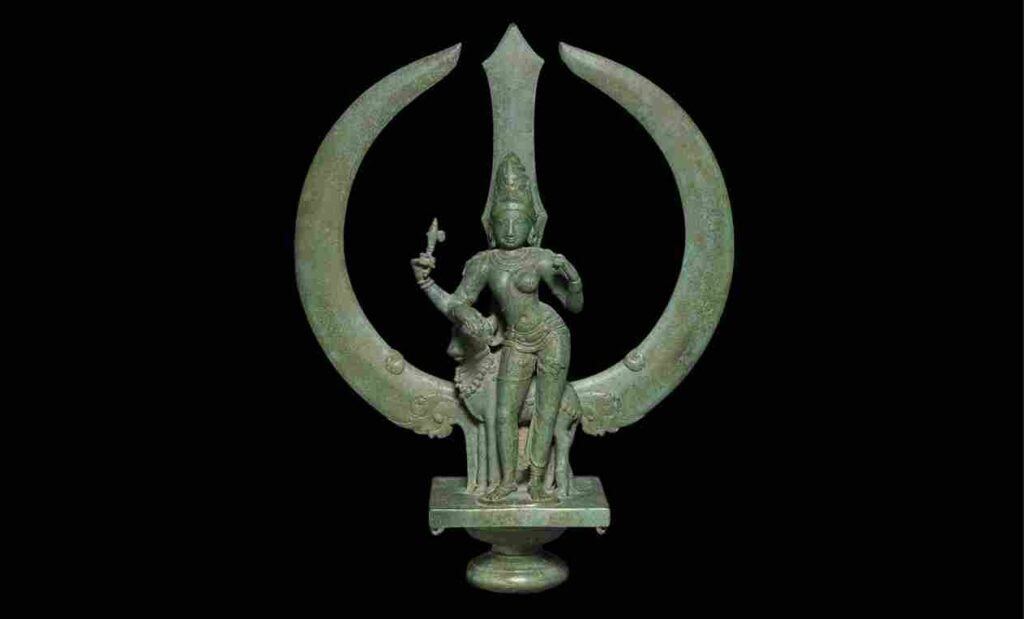
Trident with Shiva as half-woman (Ardhanarishvara), TN, circa 1050
The Cleveland Museum of Art