Atiranachanda Cave
How old is Tamil? This collection of inscriptions tells us a story of the evolution of language in these parts.
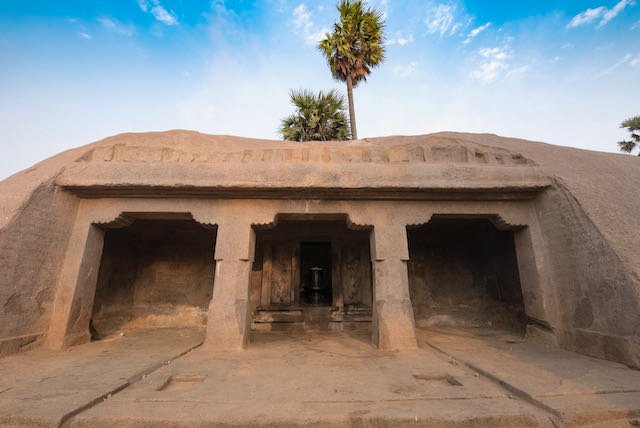
From the Yaali Mandapam, walk back towards the entrance and continue walking northwards for another 50 M. You will reach the Athiranachanda Cave. Play the next story there.
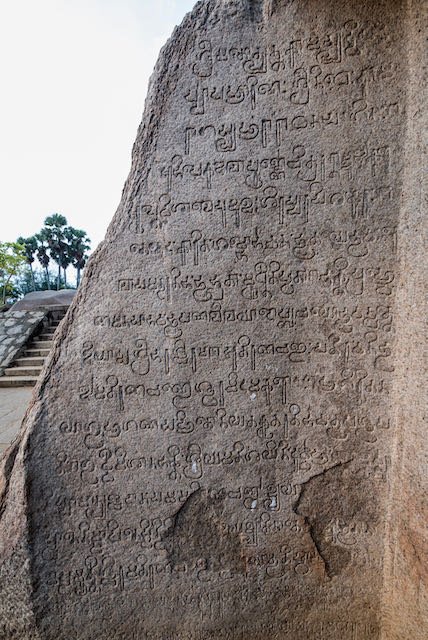
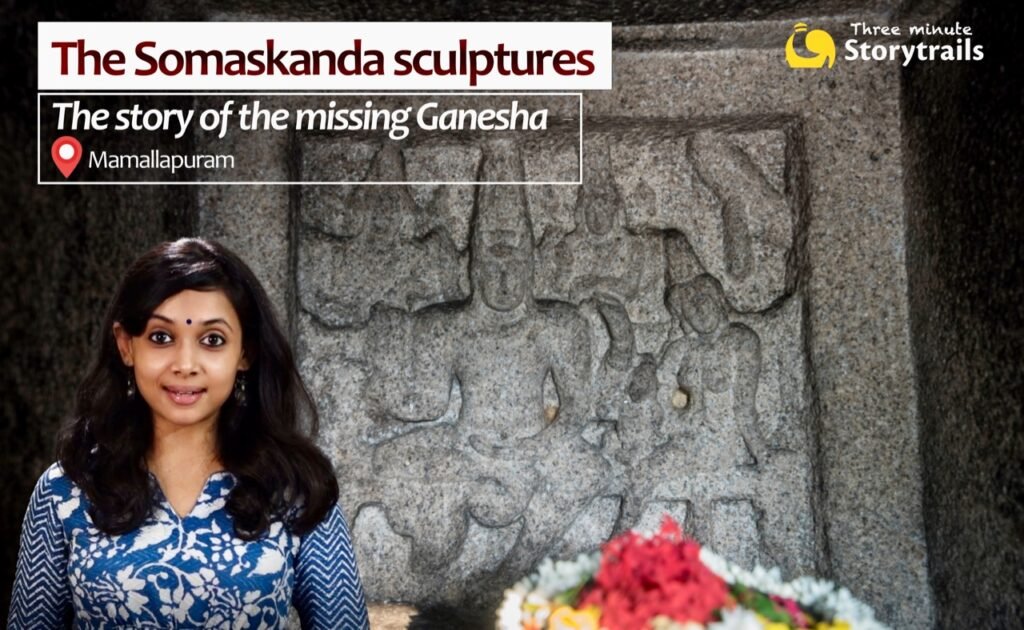
This monument is called the Athiranachanda cave temple. Athiranachanda was a title of the Pallava king Rajasimha. You can see a Shiva Lingam inside the shrine and a Somaskanda panel on the wall behind it. But the most exciting feature of this temple is the collection of three inscriptions around the main shrine. There is one on either side of the shrine. These verses glorify the Pallava king Rajasimha, and declare that he had this shrine constructed. And there is a third one on the ground in front of the cave.
The ones on the sides carry the same message but in two completely different scripts. The two scripts are Pallava Grantha and Nagari. And the language used in both inscriptions is Sanskrit. But why two scripts? To understand, let’s begin by making a distinction between a language and a script. The same language can be written in multiple scripts and the same script can be used for multiple languages. For example, French and German languages are both written in the same Latin script.
All modern Indian scripts are said to have evolved from a mother script called Brahmi which was in use in the 3rd century BCE. Brahmi, is considered to be one of the oldest scripts in south and central Asia.
At the time, the languages spoken in North India were Prakrit and Sanskrit. Both were written in the Brahmi script. Over many centuries, this Brahmi script evolved into the Nagari script in the North, which in turn gave birth to many North Indian scripts we see in use today. Down south, Sanskrit had a relatively muted presence until the Pallavas adopted it as their court language. They created a script called the Pallava grantha script to write Sanskrit. If you stand facing the monument, the inscription on your left is Sanskrit written in Pallava grantha. The inscription on the right is Sanskrit written in Nagari. This inscription is believed to be the oldest Nagari inscription in Tamil Nadu.
Let’s speak about Tamil. It too is one of the oldest surviving languages in the world with Tamil literary works going back at least 2000 years. In fact, much of south Indian history is documented in Tamil. The Tamil script also evolved from the Brahmi script. Around the 4th century CE, Tamil Brahmi evolved into a script called Vattezhuthu, which in turn evolved into the modern day Tamil script. But… not EVERYONE agrees with this theory. There is another school of thought that says Tamil evolved independently from an ancient script called Proto- tamil.
During the Pallava times, both Sanskrit and Tamil languages were in use in these parts. So Pallava grantha - the script for sanskrit co-existed in these parts with Vatta Ezhuthu which was a script for Tamil.
This collection of inscriptions tells us the story of the evolution of these languages. The Pallava grantha inscription tells us that Sanskrit was used in these parts during the Pallava period. Kancheepuram, the Pallava capital,had become a famous seat of Sanskrit learning and many significant works were composed in Sanskrit. This was the last flowering of the language in South India and after the Pallavas, Sanskrit gradually declined in these parts. The Nagari inscription tells us of the movement of religion, language and ideas across India during that period.
The inscription on the ground dates to a later period, the 10th century Chola period. It is written in Tamil and it records the donation of 90 sheep for burning of perpetual lamps. That tells us that by the time of the Cholas in the 10th century, Tamil had already become the predominant language of these parts. In fact it had even spread overseas. Till date, Tamil is an official language in Singapore, Malaysia and Sri Lanka.

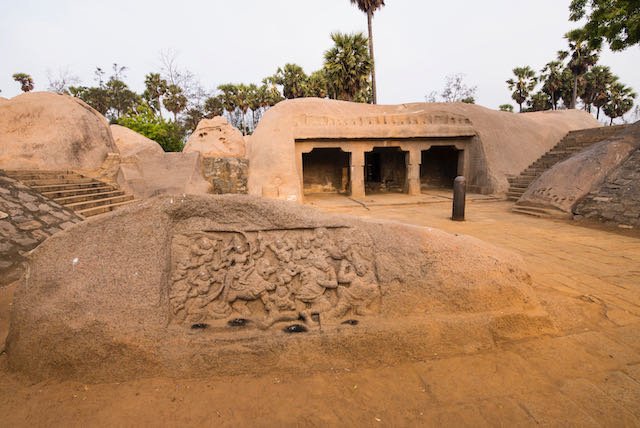
Atiranachanda Cave with Mahishasura Mardhini panel in the foreground
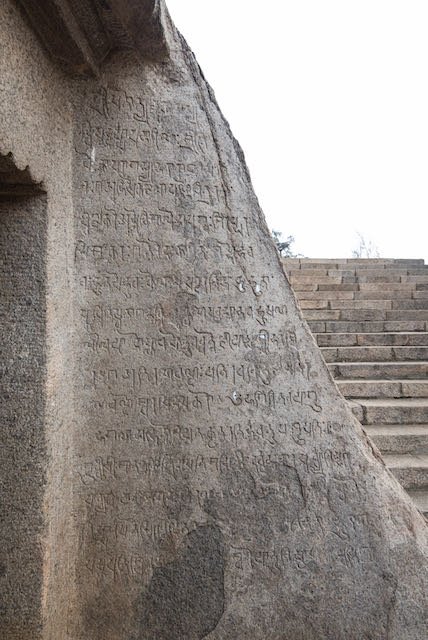
Nagari inscription on the northern side of the Atiranachanda Cave, commissioned by King Rajasimha