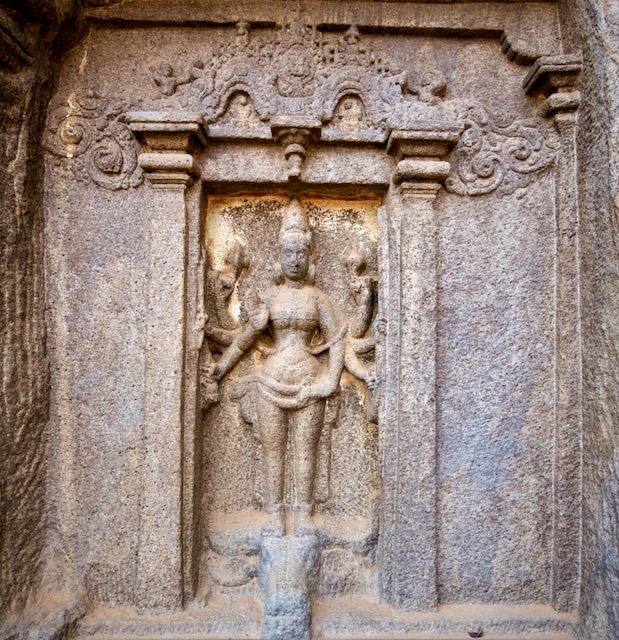
Trimurti Cave
How do historians piece together the story of a monument by looking at eroding sculptures? How can they identify the three idols in the Trimurti Cave?
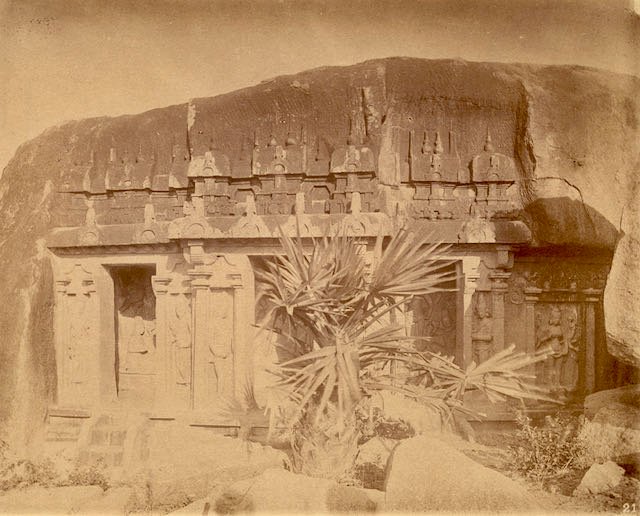
From the Butterball, walk northwards for about 80 M. The path turns right at a large rock face. To your right is the Trimurti Cave. Play the next story here.
This cave is called the Trimurti cave, literally meaning “three idols.” For a long time, locals assumed that the idols inside these shrines represented the three big Gods of Hinduism - Brahma, Vishnu, and Shiva. But some historians insist that these are idols of Vishnu, Shiva and Muruga – the warrior god and son of Shiva. How did they find that out? How, for that matter, does anyone piece together the story of any such monument, when most idols look very, very similar?
There are clues everywhere, if you know where to look. First, you have the Agama Shastras and Shilpa Sastras - ancient scriptures that dictate rules for building temples and sculpting figures of gods. They specify the grammar, the proportions, and the iconography. All idols of deities are built to these exact specifications. So Lord Shiva is usually represented as holding an axe in his hands, just as he is seen in the central shrine here. And Lord Vishnu is invariably depicted carrying a conch shell and a discus in his hands, as you can see in the shrine on the right.
But the third statue - the one inside the shrine on the left - is shown wearing chain armour on his breastplate – very unlike Brahma, the god of creation. So historians surmise that it must be a statue of Muruga – the warrior god, son of Shiva, and a very important God in these parts. He holds a lotus and prayer beads in his hands which makes some historians believe that he could be Brahmasasta—a more ancient icon of Muruga. Brahmasasta was particularly popular during Pallava times.
Scholars also rely on the postures and hand gestures of the sculptures to identify them. Here both Shiva and Vishnu have raised right hands, elbows bent and palms facing outwards. This pose is called abhaya mudra - or gesture of reassurance. So it is associated with protection and can be typically seen on Hindu gods. On the other hand, the dwarapalas or sentries at the entrance to the Vishnu cave have their hands in a posture called the Tarjani Mudra – which cautions you that you are in the presence of God.
Then there is the proverbial writing on the wall. Epigraphy, which is the study of inscriptions, often helps scholars date a monument. Local literature and travel accounts of foreign visitors add one more layer of clues.
But even with all these clues, historians often have to make educated guesses from circumstantial evidence. And almost always, that leads to multiple interpretations. Take for example, the Arjuna’s penance bas-relief. As we saw earlier, one group of historians interprets the scene as a story from Mahabharata while another group sees it as a story from the Ramayana. Same evidence, different interpretations. That debate still rages on.

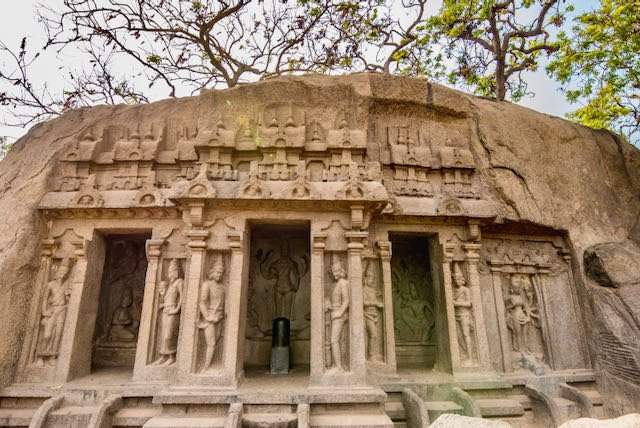
Trimurti Cave. Left to Right: Caves of Murugan, Shiva, Vishnu, and bas-relief of Durga
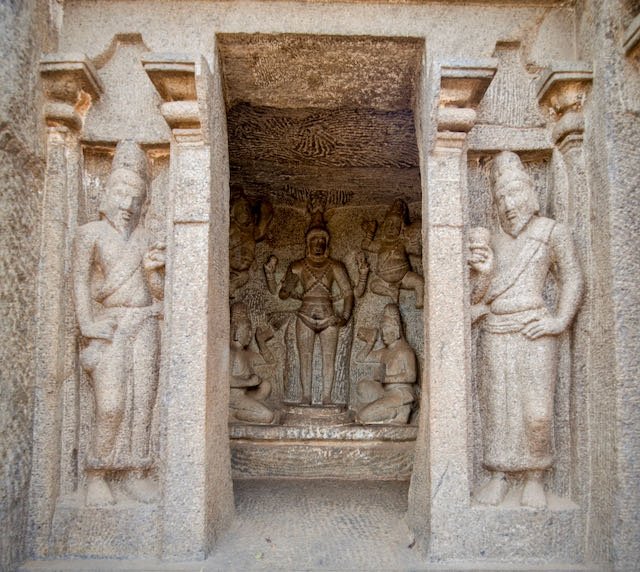
Lord Murugan in a war-like pose: note the chain across the breast-plate
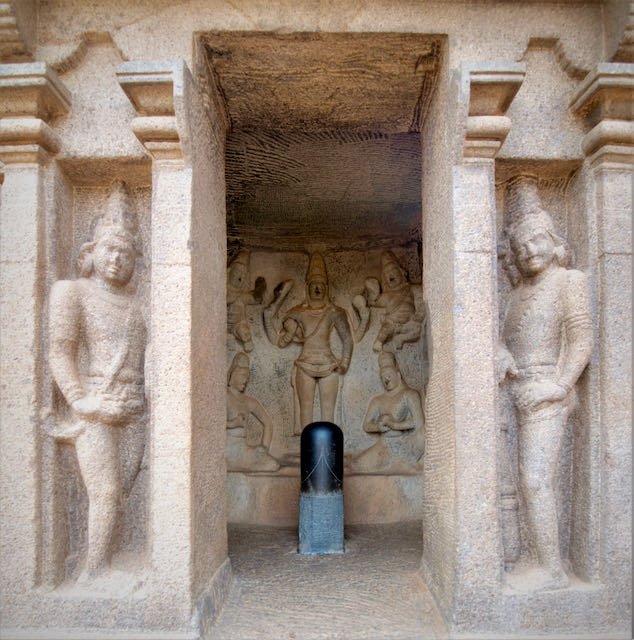
Lord Shiva in the central cave
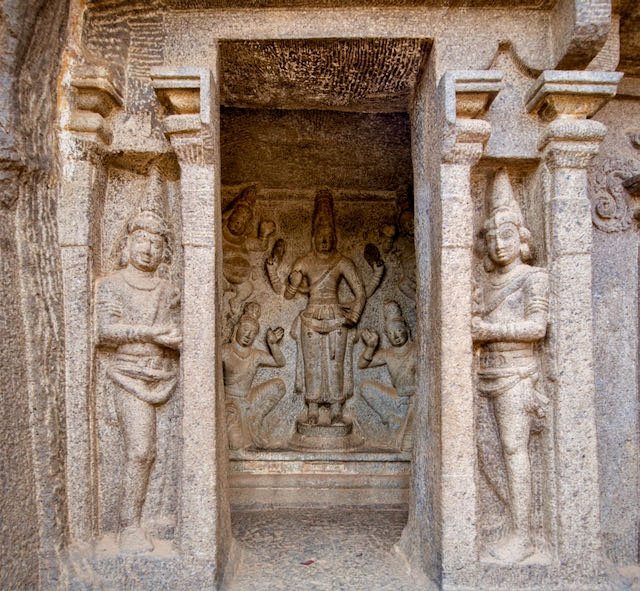
Lord Vishnu with four arms. Notice the beautifully carved Dwarapalas (guards at the door).