Descent of Ganga - Bhageeratha
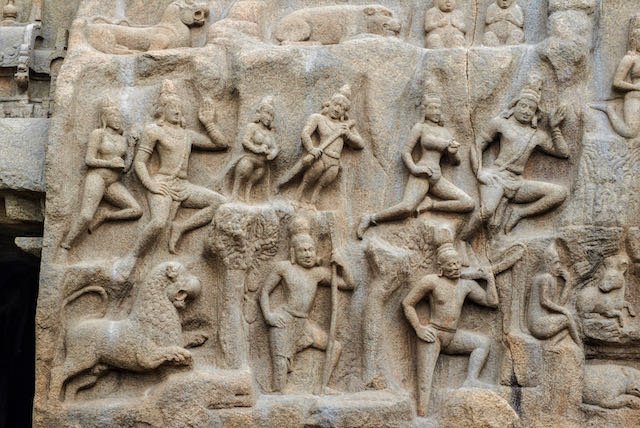
A dip in the holy river Ganga is said to rid you of a lifetime's worth of sins. This bas-relief tells the story of a sage who brought the Ganga to Earth from heaven.
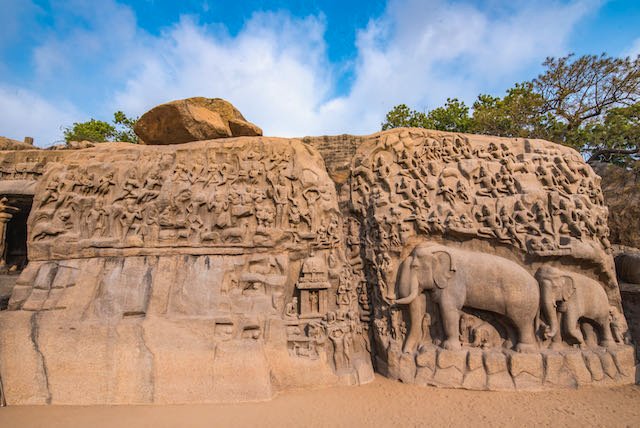
Walk back towards the parking lot. On the other side of the road you can see a large open air rock carving. Play the next story there.
This location is linked to multiple stories. You can see the list of stories on your screen. You can play them all in the same order or click on any story you wish to play
This rock carving is believed to be the largest open-air bas-relief in the world. A bas relief is a slightly projected sculpture that is carved onto a flat surface. Before the Pallavas learnt to build structural temples like the Shore temple, they excelled in carving brilliant bas-reliefs like these. In the 7th century, when this bas-relief was built, it would have directly faced the waterfront and welcomed seafaring traders from all over the world.
If you take a closer look, you will see that the bas-relief actually depicts a scene from a story. But depending on whom you ask, this bas-relief tells two completely different stories from Hindu mythology - one, the story of the Descent of the Ganga and the other, the story of Arjuna’s Penance. Let us start with the story of the descent of Ganga.
There once lived a King named Sagara, an ancient ancestor of Lord Rama. At one time, he sent his 60,000 sons and the royal army on a conquest. As the huge army marched, they accidentally disturbed a sage in deep penance. The furious sage cursed them and every one of the 60,000 was instantly burnt to ashes and scattered over a vast area.
In Hinduism, when a man dies, his body is cremated and the ashes immersed in water. Only then, they say, can the soul ascend to heaven. But the ashes of these 60,000 men could not be collected and their souls wandered around. Many generations later, a descendant of the same dynasty, King Bhageerata decided to do something about this. He decided to wash the ashes of his ancestors in the pure waters of the river Ganga. Back then, the river Ganga flowed not on land, but in the heavens. Now if the Ganga were to flow over the ashes of his ancestors, it would not only redeem their souls; it would ensure prosperity for all the people in his kingdom. So Bhageeratha sat and prayed to lord Shiva. After years of penance, Shiva granted him his wish and ordered Ganga to flow down to earth. But Ganga wasn’t too pleased with this task. Miffed, she decided to descend to earth with such force that it would throw the world off course. So Shiva stepped in to take the full force of Ganga’s descent. He trapped Ganga in his long hair and gently released her to the earth. The river flowed over the ashes of Bhageeratha’s ancestors, thus completing the ritual.
The Pallava sculptors have captured the dramatic moment in the story so vividly on the bas relief. The natural cleft in between the two boulders has been cleverly woven into the storyline, and represents Ganga. You can spot Bhagiratha standing deep in penance, and Shiva granting him the boon. Other Gods and celestial beings in the top level, and humans and animals in the second level look on in admiration. Bhagiratha seems to be deep in a forest inhabited by wildlife of all kinds. There is a cat pretending to perform penance, waiting to pounce on unsuspecting rats. There is a lion, a tiger, a boar and on the northern face, some very finely sculpted elephants. You can see the river Ganga falling from the heavens and flowing down to the netherworld which is inhabited by the nagas or the snake gods.

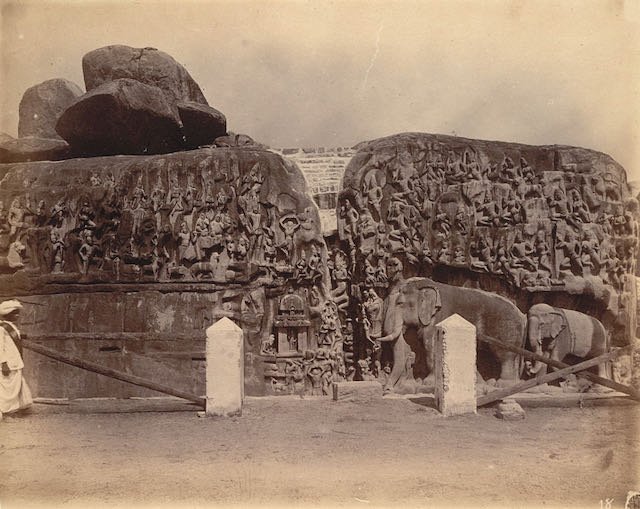
Arjuna's Penance, 1885
British Library. By Alexander Rea, 1885
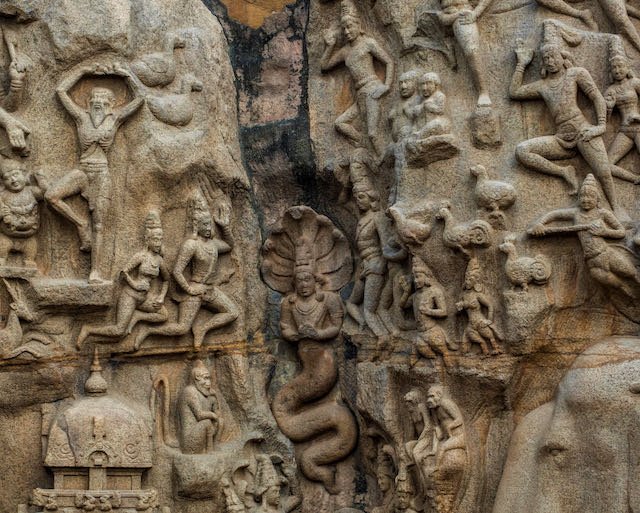
Bhageeratha, all skin and bone because of his penance, is on the top left of the panel.
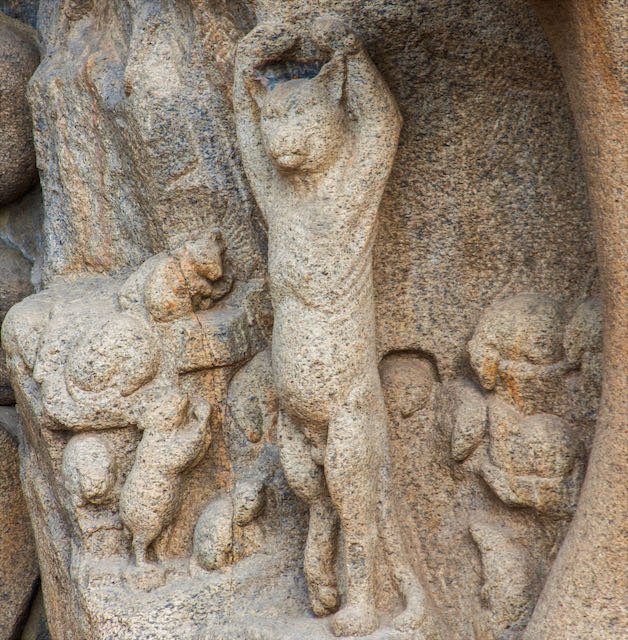
Sculptor's humour: A cat pretends to pray, while actually waiting to trap the mice below.