Seven Pagodas
Why is the Shore Temple considered the pinnacle of temple architecture in Mamallapuram? What is the myth of the Seven Pagodas?
From the Five Rathas monument, drive Northwards on Highway 239 to Mada koil street and then to East Raja street. Turn right after the Sculpture Museum on to Beach road, to go towards the Shore temple. It is about 2 KMs away from the Five Rathas monument. You can park your car at the Shore temple parking lot. Play this story at the entrance to the monument as you walk towards it
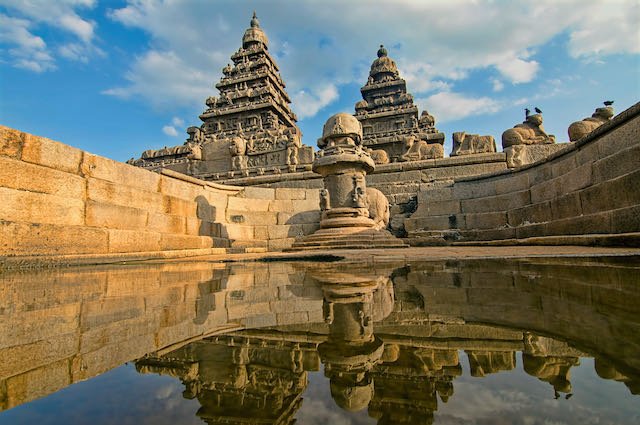
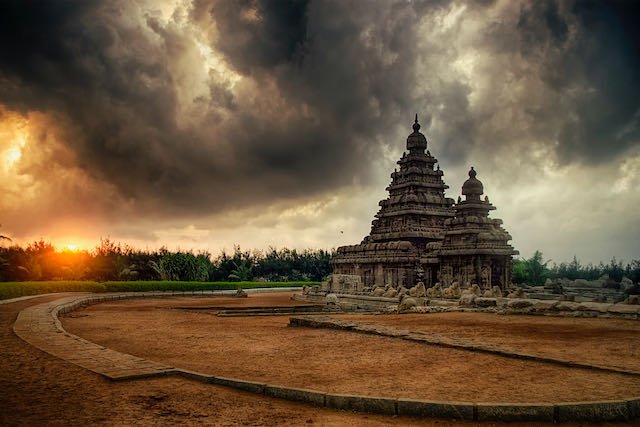
If there is a single monument that represents the pinnacle of temple architecture in Mamallapuram, it is this one - The Shore temple. It is this little temple that became the prototype of many of the largest temples we see in Tamil Nadu today. This structure marked an important evolutionary step in temple building. Up until the 8th century, temples in these parts could be built only where there was a huge rock available. So, most temples were cut into rock faces or cut out of monolith rocks.
By the beginning of the 8th century, building techniques had evolved to a stage where huge rocks could be moved and assembled one over the other. This allowed a king to build his temples wherever he pleased. And temple structures could now be much taller than any individual piece of rock. By the end of the Pallava reign, temples with very tall towers were fairly common in Tamil Nadu. The Shore temple is considered to be one of the earliest structural temples in South India.
For nearly 1300 years, the Shore temple has stood by these waters welcoming seafarers nearing this coastline. When the European powers started arriving in India, their sailors often mentioned spotting 7 pagodas or multi storeyed religious towers here. The legend was that there stood a line of seven pagodas looking out into the Bay of Bengal, welcoming sailors to a magnificent city.
While there is still not enough archaeological evidence to prove the existence of 7 Pagodas, many other structures were uncovered during the excavations around the Shore temple complex in recent times. Do you spot a well-like area with a cylindrical shrine and a boar-like statue just north of the main towers? That area was discovered only about 30 years ago. That boar is Varaha - an avatar of Lord Vishnu. During Pallava times, the well would have been filled with water, and would have made for a very pretty sight.
In December of 2004, a massive tsunami hit the eastern coast of India. The sea waters receded nearly half a kilometer, and large parts of the beach at Mamallapuram had its sand washed away. That revealed clues of ancient structures lying under the sea and buried in the sand. It is believed that Mamallapuram still holds on to many such secrets buried deep underground.

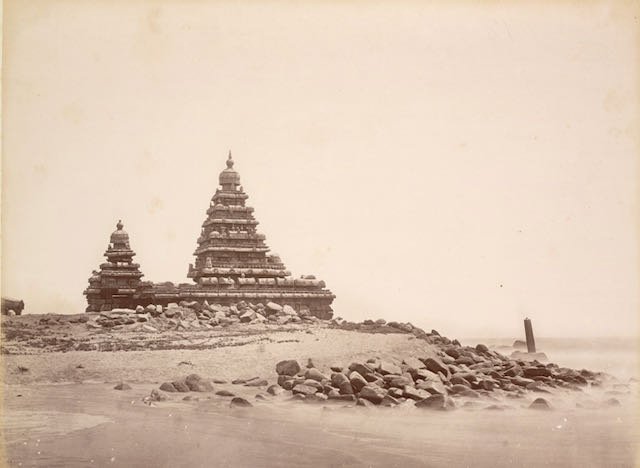
Shore Temple, 1885
British Library. By unknown photographer, 1885
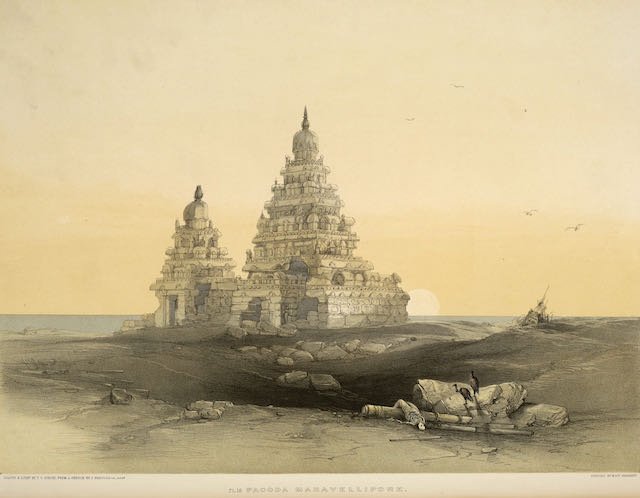
Lithograph of Shore Temple, 1847
British Library. By Thomas Coleman Dibdin, 1847